What Is ECMO?
ECMO Explained: Understanding Heart and Lung Life Support
By Dr S. Nishanth
MD, DNB (General Medicine), MRCP (UK), FNB (Critical Care), EDIC, FECMO
Internist, Intensivist & ECMO Consultant
Head, Department of Critical Care Medicine, SKS Hospital and Postgraduate Medical Institute, Salem
Published: 30 October 2026
The Short Answer
ECMO (extracorporeal membrane oxygenation) is a life-support treatment for people whose heart or lungs are too weak to work, when other treatments have not helped but recovery is still possible [1]. A machine takes over the work of the failing organ so that it can rest and heal.
In one line: ECMO does not cure the illness. It buys time for the body and the doctors to treat it [1].
Key points for families:
- It is used only in very sick patients, usually in an ICU.
- It supports either the lungs alone or the heart and lungs together [1].
- It can last from a few days to several weeks [1].
- It carries real risks, such as bleeding and clots [1,2], so it is offered only when the benefit is likely to outweigh them.
Calm questions. Clear answers. Informed decisions.
ECMO in Detail: Four Things Every Family Should Know
When a loved one is critically ill, ECMO can sound frightening. As an intensivist and ECMO consultant, I find that families cope best when they understand what the machine does and does not do. These are the four points I explain most often.
1. How ECMO Works
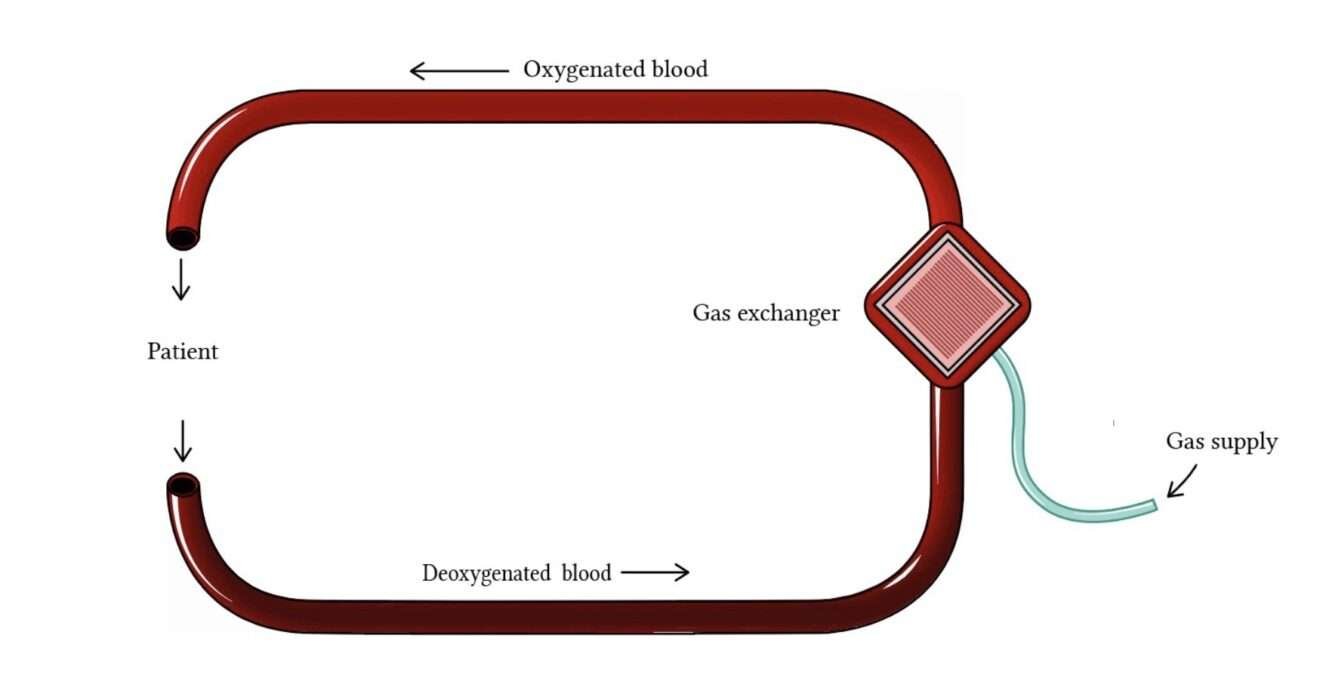
Think of ECMO as an artificial lung and heart placed outside the body. Thin tubes called cannulas are placed in a large blood vessel, in the neck, groin or chest. A pump draws blood out of the body and sends it through an artificial lung that removes carbon dioxide and adds oxygen. The blood is then returned to the body [1].
- The patient may also remain on a ventilator [1].
- Blood-thinning medicine is given to stop clots forming in the circuit [1,2].
- The ECMO team monitors the patient, the circuit and the machine closely, around the clock.
2. Two Types: Supporting the Lungs or the Heart
- Venovenous (VV) ECMO supports only the lungs. The heart keeps pumping the blood on its own [1].
- Veno-arterial (VA) ECMO supports both the heart and the lungs [1].
The choice depends on which organ is failing. Your ECMO team will explain which type your relative needs.
3. When Is ECMO Used?
ECMO is considered when the lungs or heart have failed despite the best standard treatment. Conditions where it may be used include [1]:
- Severe lung failure (ARDS), including from pneumonia, influenza and COVID-19
- Blood clots in the lungs (pulmonary embolism)
- Heart attack complications and cardiac arrest
- Support while waiting for, or recovering from, a lung or heart transplant
ECMO is not right for everyone. It is meant for patients who still have a chance of recovery [1]. Deciding who benefits is a careful clinical judgment, made case by case.
What does the evidence show? In the EOLIA trial of 249 adults with very severe ARDS, 35% of patients given early ECMO had died at 60 days, compared with 46% on the best conventional care. This difference was not statistically significant on its own, partly because many patients in the comparison group were switched to ECMO as a rescue (28%). A later combined analysis of two trials reported a lower risk of death with ECMO at 90 days (relative risk 0.75) [3]. ECMO also caused more bleeding that needed transfusion (46% against 28%) [3]. The results apply best to centres with experienced ECMO programmes [3].
4. Risks, Recovery and What Comes After
ECMO is a serious treatment, and the team will discuss its risks with you honestly. The main ones are [1,2]:
- Bleeding, because of the blood thinner, which can occur anywhere, including the brain
- Blood clots in the circuit or in the patient’s blood
- Infection, so patients are watched closely
- Stroke and seizures
- Problems with blood flow to a limb
- Equipment problems, or a cannula coming loose, which the trained team is prepared to handle
When the patient improves, doctors gradually reduce ECMO support in a trial period. If improvement continues, ECMO is stopped and the tubes are removed [1]. Because patients can be very weak after a long illness, many need physical therapy to rebuild muscle strength [1].
Common Questions
Does going on ECMO mean my relative will not survive?
No. ECMO is used so that the patient has time to recover, and it is offered to those who still have a chance of recovery [1]. It does, however, mean the illness is very serious.
Is ECMO a cure?
No. It supports the heart or lungs while the underlying problem is treated [1].
How long does it last?
It depends on the illness, from a few days to several weeks [1].
Who can provide ECMO?
ECMO needs a trained team and a well-equipped ICU. Outcomes are best in centres with experience [3]. This is why early discussion with an ECMO-capable centre matters when a patient is deteriorating.
Key Takeaways
- ECMO is an artificial lung (and sometimes heart) support outside the body.
- It does not cure disease. It gives time for recovery.
- VV ECMO supports the lungs. VA ECMO supports the heart and lungs.
- It is used for patients who have failed standard treatment but can still recover.
- It carries risks, mainly bleeding and clots, so it is offered carefully.
- Ask the team questions. Understanding the treatment helps families decide with confidence.
About the Author
Dr S. Nishanth (MD, DNB General Medicine, MRCP UK, FNB Critical Care, EDIC, FECMO) is an Internist, Intensivist and ECMO consultant with over 15 years of clinical experience. He is Head of the Department of Critical Care Medicine at SKS Hospital and Postgraduate Medical Institute, Salem, where he leads an ICU team offering advanced life support, including ECMO for severe heart or lung failure.
Contact: SKS Hospital and Postgraduate Medical Institute, Salem – 636004 | +91 88070 86743 | nishanth.aarnish@gmail.com
Website: drsnishanth.com Instagram: @dr_s.nishanth
References
- American Lung Association. Extracorporeal Membrane Oxygenation (ECMO). https://www.lung.org/lung-health-diseases/lung-procedures-and-tests/ecmo (accessed 30 October 2026)
- UCLA Health. Risks of ECMO. https://www.uclahealth.org/heart/ecmo/risks-of-ecmo (accessed 30 October 2026)
- Combes A, et al. Extracorporeal Membrane Oxygenation for Severe Acute Respiratory Distress Syndrome (EOLIA trial). N Engl J Med 2018. Summary used: Critical Care Reviews, EOLIA. https://criticalcarereviews.com/foundational-trials/eolia (accessed 30 October 2026)
- Extracorporeal Life Support Organization (ELSO). ECMO Resources for Patients & Families. (Further reading.) https://elso.org/ecmo-resources/patientsandfamilies.aspx
Disclaimer: This article is for public awareness and does not replace advice from your treating doctor. ECMO decisions are made individually by the treating ICU team together with the family.