When Should You Get Admitted for Dengue?
The Short Answer
Most people with dengue can be managed at home with rest, steady fluids and early review by a doctor. But the illness can turn serious quickly, and knowing when to come to hospital matters. Anyone with warning signs needs to be admitted [2].
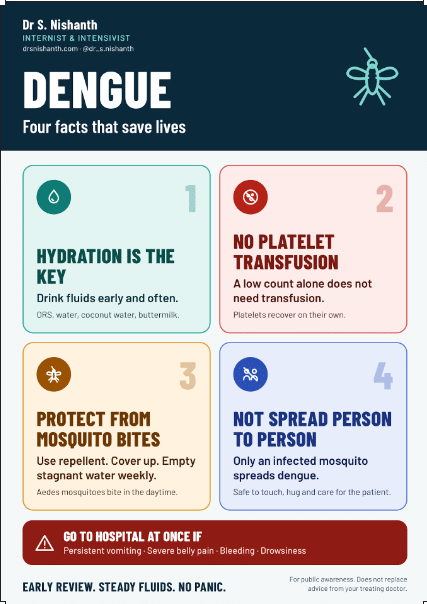
Go to the hospital at once if you have [1,3]:
- Persistent vomiting
- Severe belly pain
- Bleeding: from the nose or gums, or blood in vomit or stool
- Drowsiness or unusual restlessness
- Rising hematocrit/PCV
- Platelets count less than one lakh
A lower threshold for admission applies to infants under one year, adults over 65, pregnant women, and people with conditions such as diabetes or obesity, and to anyone who cannot tolerate oral fluids or has limited access to healthcare [2]. In practice, I also advise early admission if you live alone or far from a hospital.
Early review. Steady fluids. No panic.
Dengue in Detail: Four Facts That Save Lives
Dengue is a viral infection that rises sharply during and after the monsoon in India. As an internist and intensivist, I see how much the outcome depends on a few simple things done early. These are the four facts I want every family to know.
1. Hydration Is the Key
Fluids are the most important part of home care. For patients without warning signs, drinking plenty of fluids by mouth is usually sufficient, and intravenous fluids are not routinely needed [2]. Keeping the body well hydrated protects the circulation during the phase when plasma can leak from the blood vessels.
- Start drinking fluids early and keep drinking often.
- Good choices include ORS, plain water, coconut water and buttermilk.
- Use paracetamol (acetaminophen) for fever and body ache [2,3].
- Avoid aspirin and NSAIDs such as ibuprofen, which can increase the risk of bleeding [2,3].
- Do not take steroids on your own. They are not routinely recommended for dengue [2]. Dengue is a viral illness, so antibiotics do not treat it either.
If you cannot keep fluids down, seek care immediately.
2. A Low Platelet Count Alone Does Not Need a Platelet Transfusion
This is the most common source of fear and confusion in dengue. Preventive (prophylactic) platelet transfusions are not recommended. Transfusion is reserved for significant active bleeding, particularly when the patient is unstable, or when the haematocrit falls despite adequate fluids [2].
- Transfusion is not needed simply because the number is low.
- The decision rests on how the patient is doing: symptoms, vital signs, fluid status and bleeding.
- In my clinical experience, platelet counts recover as the illness settles.
Repeated check-ups and blood tests guide care, not the platelet count alone.
3. Protect Yourself from Mosquito Bites
Dengue is spread mainly by the Aedes aegypti mosquito, which is active during the day. Protection matters most in daylight hours [3]. WHO recommends:
- Cover up with clothing that covers as much skin as possible.
- Use repellents containing DEET, picaridin or IR3535, and use window screens and nets, including for daytime sleep.
- Remove breeding sites: dispose of solid waste properly and remove containers that hold water.
- Cover, empty and clean water storage containers weekly.
Environmental control is a community effort, since one breeding site can affect a whole neighbourhood [3].
4. Dengue Does Not Spread Through Everyday Contact
The main route of dengue is the bite of an infected mosquito. Spread by other routes is rare, and has been reported through blood products, organ donation and transfusion, and from mother to baby [3].
Touching, hugging, sharing a room or caring for a patient does not spread dengue, so it is safe to look after someone with the illness. Patients need comfort and company. The one precaution is to keep the patient away from mosquito bites, with a net or repellent, so that mosquitoes do not pick up the virus and pass it on to others.
Know the Course of the Illness
Symptoms usually begin 4 to 10 days after infection and last 2 to 7 days [3]. They include sudden high fever, severe headache, pain behind the eyes, muscle and joint pain and rash, and sometimes minor bleeding such as nosebleeds or bleeding gums [1].
The critical phase begins when the fever falls and usually lasts 24 to 48 hours [1]. It typically occurs about 3 to 8 days after the fever begins [2]. Warning signs often appear around this time, and may show up after the fever has gone [1,3]. A patient who looks better can worsen at this point, which is why follow-up and monitoring continue even when the temperature settles.
Key Takeaways
- Drink fluids early and often.
- A low platelet count alone does not need a transfusion.
- Protect yourself from daytime mosquito bites and empty stagnant water weekly.
- Dengue is not spread by touch or everyday contact, so care for your loved ones without fear.
- Go to the hospital at once for persistent vomiting, severe belly pain, bleeding or drowsiness.
About the Author
Dr S. Nishanth (MD, DNB General Medicine, MRCP UK, FNB Critical Care, EDIC, FECMO) is an Internist, Intensivist and ECMO consultant with over 15 years of clinical experience. He is Head of the Department of Critical Care Medicine at SKS Hospital and Postgraduate Medical Institute, Salem, and offers care from outpatient consultations to ICU management, including fever and sepsis, diabetes, hypertension, pneumonia and ARDS, and advanced life support with ECMO.
Contact: SKS Hospital and Postgraduate Medical Institute, Salem – 636004 | +91 88070 86743 | nishanth.aarnish@gmail.com
Website: drsnishanth.com Instagram: @dr_s.nishanth
References
- Centers for Disease Control and Prevention (CDC). Clinical Features of Dengue. https://www.cdc.gov/dengue/hcp/clinical-signs (accessed 30 October 2026)
- Centers for Disease Control and Prevention (CDC). Clinical Care of Dengue. https://www.cdc.gov/dengue/hcp/clinical-care/ (accessed 30 October 2026)
- World Health Organization (WHO). Dengue and severe dengue (fact sheet). https://www.who.int/news-room/fact-sheets/detail/dengue-and-severe-dengue (accessed 30 October 2026)
- World Health Organization (WHO). Guidelines for clinical management of arboviral diseases: dengue, chikungunya, Zika and yellow fever. July 2025. (Further reading.) https://www.who.int/publications/i/item/9789240111110 (accessed 30 October 2026)
Disclaimer: This article is for public awareness and does not replace advice from your treating doctor. If you or a family member has fever with any warning signs, seek medical care promptly.