Antibiotic Misuse: Do You Really Need an Antibiotic for That Fever?
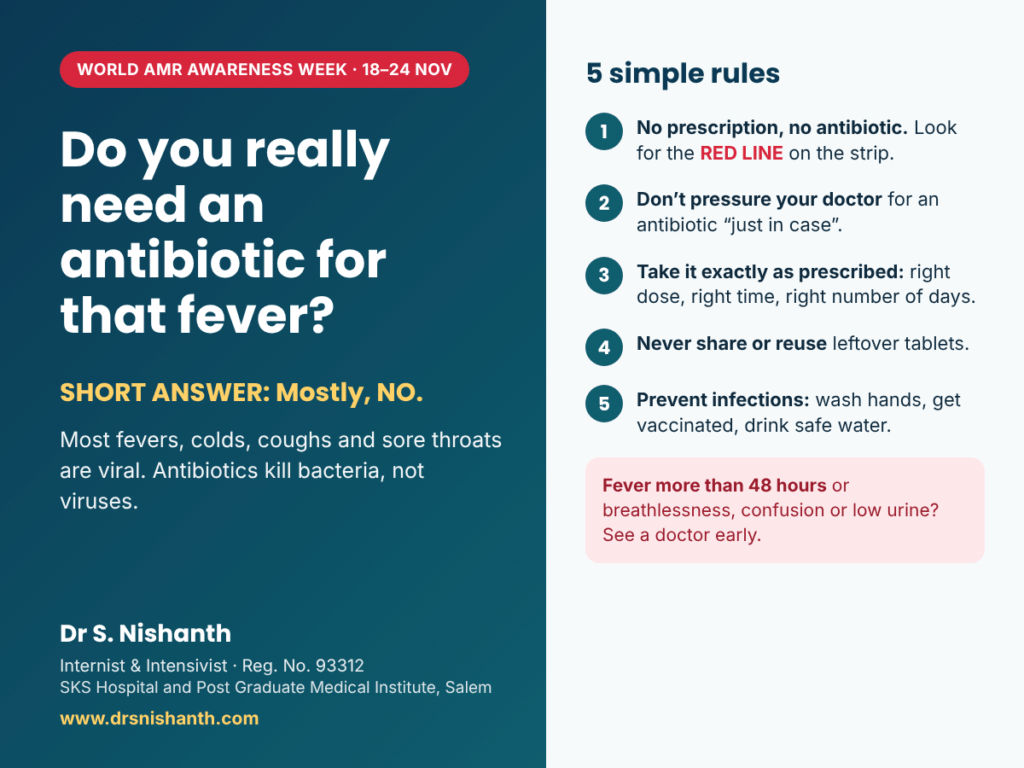
Antibiotic misuse is one of the biggest silent threats to your family’s health. This week, from 18 to 24 November, the world observes World AMR Awareness Week. So, in simple language, here is what every family should know about antibiotics.
Short answer: Most fevers, colds, coughs and sore throats are caused by viruses, and antibiotics do not work on viruses. Therefore, take an antibiotic only when a doctor prescribes it for a bacterial infection. Antibiotic misuse creates “superbugs”, which are bacteria that no longer respond to treatment.
What is antibiotic misuse?
Antibiotic misuse means using an antibiotic when it is not needed, or using it the wrong way. For example, it includes buying antibiotics at a pharmacy without a prescription. It also includes stopping tablets early, taking leftover tablets from an old illness, or sharing them with a family member. In addition, taking a stronger antibiotic than needed is also misuse.
Why don’t antibiotics work for most fevers and colds?
Antibiotics kill bacteria. However, most common illnesses are caused by viruses, which are a completely different kind of germ. For instance, the common cold, flu, most sore throats, most coughs and dengue are viral. Similarly, most loose motions settle with fluids alone.
As a result, an antibiotic in these illnesses gives no benefit, only side effects. In fact, the ICMR treatment guidelinesadvise doctors to avoid antibiotics for low-grade fever, viral sore throat and viral bronchitis. Most viral fevers settle in a few days with rest, fluids and paracetamol as advised by your doctor. You can read more in my article I Have a Fever. What Should I Do?
When are antibiotics actually needed?
Antibiotics are life-saving when there is a true bacterial infection. Typical examples are pneumonia, urinary tract infection, typhoid, infected wounds and sepsis. Even then, the right drug, dose and duration matter. That is why your doctor examines you first and, when needed, orders blood, urine or culture tests.
In other words, the decision to start an antibiotic is a medical one. It should never be made at the pharmacy counter.
What harm does antibiotic misuse cause?
Antibiotic misuse harms you in three ways.
- It creates superbugs. Every unnecessary course kills the weak bacteria first. Consequently, the tough ones survive, multiply and spread to others.
- It causes side effects. Antibiotics can cause diarrhoea, rashes, serious allergic reactions and, rarely, liver or kidney injury. They also disturb the healthy bacteria in your gut.
- It costs more. When common drugs stop working, patients need costlier injections, longer hospital stays and sometimes ICU care.
In the ICU, we see the end result of antibiotic misuse almost every day. Sadly, some patients have infections for which very few drugs, or none, still work.
How serious is antibiotic resistance in India?
The problem is already here. According to the WHO Global Antibiotic Resistance Surveillance Report 2025, about one in three lab-confirmed bacterial infections in the South-East Asia region resisted standard antibiotics. Globally, the figure was about one in six.
Furthermore, a major study in The Lancet forecasts 11.8 million deaths directly due to resistant infections in South Asia between 2025 and 2050. ICMR’s national surveillance network has also reported falling effectiveness of key antibiotics used for pneumonia, sepsis and typhoid. Clearly, reducing antibiotic misuse is now a matter of public health, not just personal health.
What is the “Red Line” on medicine strips?
Many antibiotic strips in India carry a vertical red line. Under the Ministry of Health’s Red Line campaign, this line means the medicine must not be taken without a doctor’s prescription. Antibiotics are listed under Schedule H and H1 of the Drugs Rules, 1945. Therefore, if you see a red line, do not buy or take that medicine on your own.
Should I always “complete the course” of antibiotics?
The simplest rule is this: take the antibiotic exactly as your doctor prescribes. That means the right dose, at the right time, for the number of days advised. Many infections now need shorter courses than before, so your doctor decides the duration.
However, do not stop early just because you feel better, unless your doctor tells you to. Likewise, do not continue beyond the advised days or restart leftover tablets later. If you have side effects, call your doctor instead of stopping on your own.
How can my family prevent antibiotic misuse at home?
Here are five simple rules to stop antibiotic misuse at home:
- Never buy antibiotics without a prescription, and look for the Red Line.
- Do not pressure your doctor for an antibiotic “just in case”.
- Take it exactly as prescribed: right dose, right time, right number of days.
- Never share antibiotics or keep leftover tablets for next time.
- Prevent infections in the first place: wash hands with soap, drink safe water, eat freshly cooked food and stay up to date with vaccines.
Vaccines matter because every infection prevented is an antibiotic not needed. Therefore, adults over 60 should ask their doctor about pneumococcal and flu vaccines.
When should I see a doctor for a fever?
See a doctor if a fever lasts more than 48 hours, because it needs investigation. Also, go to a hospital urgently if fever comes with any of these warning signs:
- Breathlessness or fast breathing
- Confusion, unusual drowsiness or fainting
- Very low urine output
- Persistent vomiting or inability to drink
- A new rash, bleeding or blackish stools
- Chest pain or a severe headache with neck stiffness
A word from the ICU on antibiotic misuse
Antibiotics are among the most precious medicines we have. Yet antibiotic misuse is quietly using them up. Each family’s small choices, repeated across millions of homes, decide whether these medicines still work when our children and parents truly need them. So, this World AMR Awareness Week, let us use antibiotics wisely.
By Dr S. Nishanth, MBBS, MD, DNB (General Medicine), MRCP (UK), FNB (Critical Care), EDIC, FECMO, Head – Department of Critical Care Medicine, SKS Hospital and Post Graduate Medical Institute, Salem. Reg. No. 93312.
References
- World Health Organization. World AMR Awareness Week 2026: “One Health, one action: Prevent AMR now”. https://www.who.int/campaigns/world-amr-awareness-week/world-amr-awareness-week-2026
- World Health Organization. WHO warns of widespread resistance to common antibiotics worldwide (Global Antibiotic Resistance Surveillance Report 2025), 13 October 2025. https://www.who.int/news/item/13-10-2025-who-warns-of-widespread-resistance-to-common-antibiotics-worldwide
- GBD 2021 Antimicrobial Resistance Collaborators. Global burden of bacterial antimicrobial resistance 1990–2021: a systematic analysis with forecasts to 2050. The Lancet, 2024. Summary: https://healthdata.org/node/12106
- Indian Council of Medical Research. Treatment Guidelines for Antimicrobial Use in Common Syndromes, 2022. https://www.icmr.gov.in/
- Indian Council of Medical Research. Antimicrobial Resistance Research and Surveillance Network (AMRSN) Annual Report 2024. https://www.icmr.gov.in/icmrobject/uploads/Report/1763981012_icmramrsnannualreport2024.pdf
- Press Information Bureau, Government of India. India’s Fight Against Antimicrobial Resistance (Red Line campaign, Schedule H and H1), December 2024. https://static.pib.gov.in/WriteReadData/specificdocs/documents/2024/dec/doc2024126465601.pdf
- Ministry of Health and Family Welfare. Reply to Rajya Sabha Unstarred Question No. 417 on over-prescription of antibiotics, 6 February 2024. https://rsdebate.nic.in/bitstream/123456789/747559/1/PQ_263_06022024_U417_p407_p407.pdf