Pneumonia Symptoms: Know the Warning Signs Early (Part 1 of 2)
World Pneumonia Day – 12 November 2026 | Part 1 of 2
by
Dr S. Nishanth
MBBS, MD, DNB (General Medicine), MRCP (UK), FNB (Critical Care), EDIC, FECMO
Head – Department of Critical Care Medicine
SKS Hospital and Post Graduate Medical Institute, Salem
Reg. No. 93312 | www.drsnishanth.com | Instagram: @dr_s.nishanth
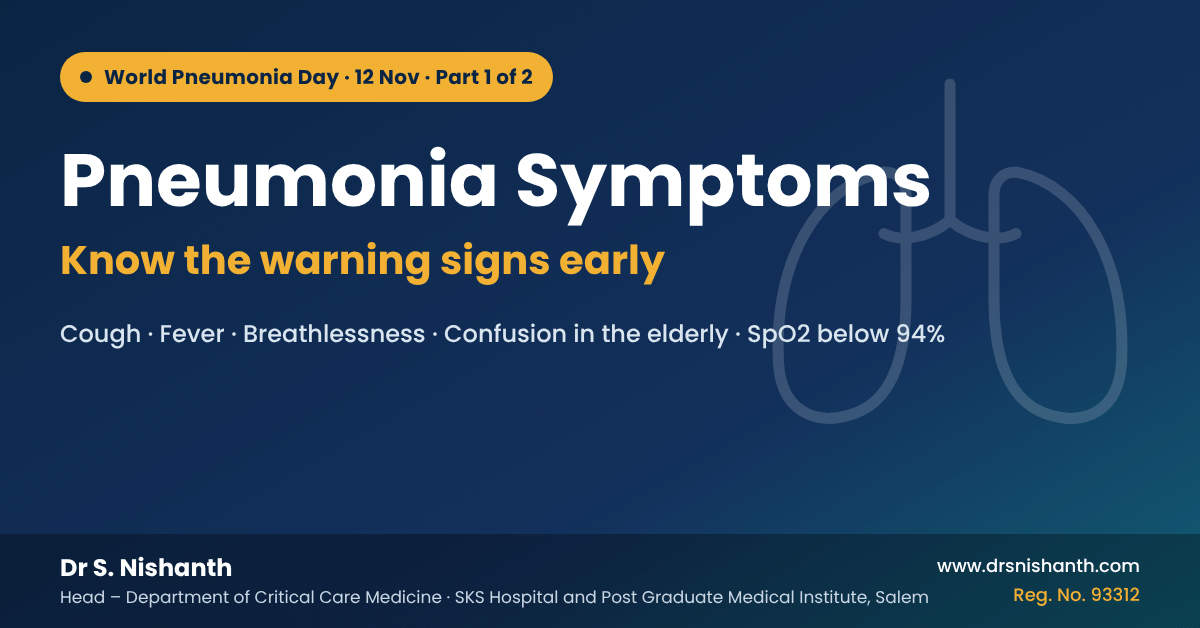
World Pneumonia Day is observed every year on 12 November, and this year’s global theme is “A New Era of Pneumonia Control”. Ahead of the day, this two-part series explains pneumonia in simple language. Part 1 covers pneumonia symptoms, who is at risk, and when you must rush to hospital. In fact, recognising pneumonia symptoms early is often the difference between a short course of tablets and a long stay in the ICU.
Q1. What exactly is pneumonia?
Short answer: Pneumonia is an infection of the lungs. The tiny air sacs fill with fluid and pus, so less oxygen reaches the blood.
First of all, our lungs contain millions of tiny balloon-like air sacs called alveoli. Normally, they fill with air every time we breathe in, and oxygen passes from them into the blood. In pneumonia, however, germs infect these air sacs. As a result, they become inflamed and fill with fluid or pus. Because of this, breathing becomes harder and the oxygen level in the blood can fall.
Pneumonia can affect one part of one lung, or alternatively, it can spread to both lungs. Moreover, it can range from a mild illness treated at home to a life-threatening condition that needs ICU care.
Q2. How are pneumonia symptoms different from a common cold or flu?
Short answer: A cold mainly affects the nose and throat. Pneumonia affects the deep parts of the lungs, so it usually causes breathlessness, chest pain and a higher, longer fever.
At first, pneumonia symptoms can look like a simple cold or flu. That is exactly why many people delay treatment, especially at home. Still, there are clear differences:
| Common cold / flu | Pneumonia |
|---|---|
| Runny nose, sneezing, sore throat | Cough, often with yellow, green or rust-coloured phlegm |
| Mild or no breathlessness | Breathlessness, even while resting |
| Fever usually settles in 2–3 days | Fever that persists or keeps returning, often with chills |
| No chest pain | Sharp chest pain that worsens on breathing or coughing |
| Normal oxygen level | Oxygen level may drop |
Also, flu itself can lead to pneumonia. So, if you had a cold or flu and you suddenly feel worse after a few days, treat it as a warning sign.
Q3. What causes pneumonia, and is it contagious?
Short answer: Most pneumonia is caused by bacteria or viruses. The germs spread through coughs and sneezes, so they can pass from person to person.
Among bacteria, the commonest cause is Streptococcus pneumoniae (the pneumococcus), as noted by the World Health Organization. Viruses such as influenza (flu), RSV and COVID-19 are also frequent causes. Fungal pneumonia, on the other hand, is rare in healthy people and is seen mainly in those with very weak immunity.
For instance, the germs that cause pneumonia travel in droplets when an infected person coughs or sneezes. Therefore, covering your mouth, washing hands and wearing a mask when you are unwell help protect the people around you. In addition, some pneumonias develop when food, saliva or vomit enters the lungs. This is called aspiration pneumonia, and we will discuss it in Part 2.
Q4. Who is more likely to get pneumonia?
Short answer: Anyone can get pneumonia, but older adults, young children, smokers and people with long-term illnesses are at the highest risk.
According to the CDC, you are at a higher risk if you:
-
- Are above 65 years of age, or the child is below 5 years
-
- Smoke, or are regularly exposed to smoke from firewood, mosquito coils or air pollution
-
- Have diabetes, especially when sugars are poorly controlled
-
- Have asthma, COPD or other lung disease
-
- Have heart failure, kidney disease or liver disease
-
- Take steroids or cancer treatment, or have HIV or another cause of weak immunity
-
- Drink alcohol heavily, which also weakens the lungs’ defences
-
- Are bedridden, or have had a stroke that affects swallowing, since food can then slip into the lungs
-
- Have recently had flu or COVID-19, or a recent stay in hospital
For these groups, pneumonia symptoms may also progress faster. Hence, they should see a doctor earlier rather than “waiting and watching”.
Q5. What are the common pneumonia symptoms in adults?
Short answer: Cough with phlegm, fever with chills, breathlessness, chest pain on breathing, and unusual tiredness are the commonest pneumonia symptoms.
In general, the typical pneumonia symptoms in adults include:
-
- Cough – often producing yellow, green or rust-coloured phlegm, and occasionally blood-streaked phlegm
-
- Fever with shivering or sweating
-
- Breathlessness – feeling short of breath while walking, talking, or even at rest
-
- Fast breathing and a fast heartbeat
-
- Chest pain – usually sharp, and worse when you take a deep breath or cough
-
- Extreme tiredness and body ache, even after rest
-
- Loss of appetite, and in addition, sometimes nausea, vomiting or loose stools
These pneumonia symptoms can appear suddenly over 1–2 days, or they can build up slowly over several days. Remember too that any fever lasting more than 48 hours needs to be investigated. You can read more about this in my article I Have a Fever. What Should I Do?.
Q6. Are pneumonia symptoms different in elderly people?
Short answer: Yes. In older adults, pneumonia may cause confusion, drowsiness, falls or refusing food, often with little or no fever and only a mild cough.
Above all, this is one of the most important messages of this article. In the elderly, the classic pneumonia symptoms are often missing. For example, an elderly person may:
-
- Become suddenly confused, drowsy or unusually quiet
-
- Stop eating or drinking
-
- Become weak and fall, or be unable to get out of bed
-
- Lose control of urine, even if this has never happened before
-
- Have no fever at all, or even a lower-than-normal body temperature
Families often think this is “just old age” or “just weakness”. Unfortunately, by the time breathlessness becomes obvious, the infection may already be severe. Consequently, any sudden change in an elderly person’s behaviour or alertness deserves a medical check-up the same day.
Q7. What are the pneumonia symptoms in children?
Short answer: Fast breathing, the chest pulling inward while breathing, grunting, and poor feeding are key warning signs in children.
Unlike adults, young children may not complain of breathlessness. Instead, watch for:
-
- First, breathing faster than usual
-
- The lower chest sinking in with each breath (chest indrawing)
-
- Grunting or wheezing sounds
-
- Refusing feeds, vomiting everything, or being unusually sleepy
-
- Bluish lips, or fits (convulsions) in severe cases
Therefore, if a child shows any of these pneumonia symptoms, take the child to a doctor immediately, as advised by the WHO.
Q8. Which pneumonia symptoms mean I must go to hospital immediately?
Short answer: Breathlessness at rest, an oxygen level below 94%, bluish lips, confusion or drowsiness, and chest pain are emergencies. Do not wait.
Go to the nearest hospital emergency department at once if you notice any of these red-flag pneumonia symptoms:
-
- Breathlessness while resting, or difficulty speaking a full sentence
-
- Breathing very fast (in adults, more than 30 breaths a minute)
-
- Oxygen saturation (SpO2) below 94% on a pulse oximeter. If you already have long-term lung disease, use the target your doctor has given you.
-
- Bluish lips, tongue or fingertips, because this means very low oxygen
-
- New confusion, drowsiness or difficulty waking up
-
- Severe chest pain
-
- Dizziness, fainting, cold hands and feet, or passing very little urine – these can be signs of sepsis
-
- Coughing up blood, even in small amounts
-
- In children: chest indrawing, grunting, or inability to feed
-
- Symptoms that do not improve within 48 hours of starting treatment, or that are getting worse
Above all, do not drive yourself if you are breathless. Instead, ask someone to take you, or call an ambulance (108). Early oxygen, the right antibiotics and timely ICU support save lives. To learn what advanced support looks like in the most severe cases, read What Is ECMO?.
Q9. How do doctors confirm pneumonia?
Short answer: The doctor examines your chest, checks your oxygen level, and usually orders a chest X-ray and blood tests.
In practice, diagnosis usually involves these steps:
-
- History and examination – the doctor asks about your pneumonia symptoms and listens to your chest with a stethoscope for crackling sounds.
-
- Oxygen saturation (SpO2) – a simple finger probe checks how much oxygen is in your blood.
-
- Chest X-ray – this confirms pneumonia and shows how much of the lung is involved.
-
- Blood tests – similarly, a complete blood count, CRP and kidney function tests help assess severity.
-
- Additional tests when needed – sputum and blood cultures, tests for flu or COVID-19, and sometimes a CT scan of the chest or an arterial blood gas test.
Using these findings, the doctor then decides whether you can be treated at home or need admission. Similarly, a monsoon fever such as dengue can sometimes look like a chest infection, so testing matters. See When Should You Get Admitted for Dengue?.
Q10. What should I do if I notice pneumonia symptoms at home?
Short answer: See a doctor early, check your oxygen level if you have a pulse oximeter, rest and drink fluids, and never start antibiotics on your own.
Do:
-
- Consult a doctor early, especially if you are in a high-risk group
-
- Check your SpO2 with a pulse oximeter, if available, two or three times a day
-
- Rest, and also drink enough water and fluids
-
- Take medicines exactly as prescribed, even after you start feeling better
-
- Cover your cough and wash your hands often
Don’t:
-
- Don’t buy antibiotics over the counter or use leftover tablets, because the wrong antibiotic can delay recovery (NHS)
-
- Don’t take strong cough suppressants without medical advice, because coughing helps clear the infection
-
- Don’t smoke, since smoke further damages the lungs
-
- Don’t ignore confusion or drowsiness in an elderly family member
For pneumonia and critical care support in Salem, see Health Conditions Managed.
Key takeaways
-
- Pneumonia is a lung infection that can lower the oxygen in your blood.
-
- Common pneumonia symptoms are cough with phlegm, fever with chills, breathlessness and chest pain.
-
- In the elderly, confusion, falls or refusing food may be the only signs.
-
- SpO2 below 94%, breathlessness at rest, bluish lips or confusion need emergency care.
-
- Finally, early treatment prevents most complications.
What’s next: Part 2 on World Pneumonia Day (12 November)
Next, tomorrow on World Pneumonia Day, Part 2 will answer the next set of questions:
-
- Can pneumonia be treated at home, or does it need admission?
-
- Why you must complete the antibiotic course, and why viral pneumonia doesn’t need antibiotics
-
- When oxygen, ICU care or ventilator support is needed
-
- Why the cough and tiredness can last for weeks after recovery
-
- Aspiration pneumonia in bedridden and stroke patients
-
- Vaccines and simple habits that prevent pneumonia
-
- Common myths about pneumonia
Read Part 2: Pneumonia Prevention, Treatment and Recovery (link goes live on 12 November)
Disclaimer: This article is for general awareness only and does not replace a consultation with a doctor. If you or a family member has any of the warning signs above, please seek medical care immediately.
Dr S. Nishanth
MBBS, MD, DNB (General Medicine), MRCP (UK), FNB (Critical Care), EDIC, FECMO
Head – Department of Critical Care Medicine
SKS Hospital and Post Graduate Medical Institute, Salem
Reg. No. 93312 | www.drsnishanth.com | Instagram: @dr_s.nishanth
References
-
- World Health Organization. Pneumonia – Health topic.
- World Health Organization. Pneumonia in children – Fact sheet.
- Centers for Disease Control and Prevention (CDC). About Pneumonia.
- National Health Service (NHS), UK. Pneumonia.
- Merck Manual (Consumer Version). Overview of Pneumonia.
- Metlay JP, Waterer GW, Long AC, et al. Diagnosis and Treatment of Adults with Community-acquired Pneumonia: ATS/IDSA Clinical Practice Guideline. Am J Respir Crit Care Med. 2019;200(7):e45–e67.
- Every Breath Counts Coalition / Stop Pneumonia. World Pneumonia Day.


1 Comment