Seizure First Aid: What to Do When Someone Has a Fit
Seizure first aid is a simple skill that every family should know, because a fit can happen at home, at school, on the bus or at work. Today, 17 November, is National Epilepsy Day in India. So, in simple words, here is what to do, what not to do, and when to rush to hospital.
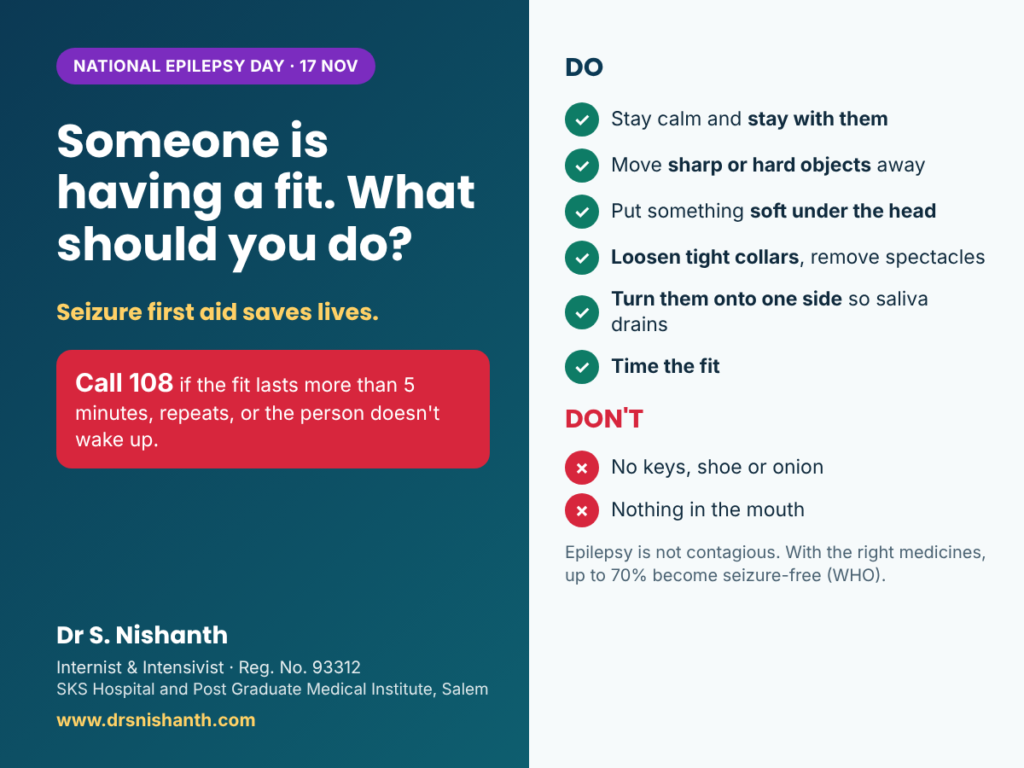
Short answer: Good seizure first aid is simple. Stay calm, keep the person safe and turn them onto one side. Never put anything in their mouth, and do not use keys, iron, onions or shoes. Time the fit. Call 108 if it lasts more than 5 minutes, if a second fit follows, or if the person does not wake up properly.
What is a seizure, and what is epilepsy?
A seizure (fit) is a sudden burst of abnormal electrical activity in the brain. As a result, the person may fall, stiffen, jerk their arms and legs, stare blankly or lose consciousness for a short time. Epilepsy means a tendency to have repeated seizures without another clear cause. According to the World Health Organization, about 50 million people worldwide live with epilepsy. In India, the estimate is more than 10 million people.
However, not every fit is epilepsy. For example, high fever in young children, very low blood sugar, head injury, brain infections, alcohol withdrawal and some poisonings can also cause a seizure. That is why every first fit needs a doctor’s evaluation.
What are the steps of seizure first aid?
Seizure first aid is mainly about keeping the person safe until the fit stops on its own. Most fits stop within one to two minutes. Therefore, follow these seizure first aid steps:
- Stay calm and stay with the person. Note the time when the fit started.
- Protect them from injury. Move away sharp, hot or hard objects. Also, keep them away from fire, water, stairs and roads.
- Cushion the head. Place something soft, such as a folded towel or bag, under the head.
- Loosen tight clothing around the neck and remove spectacles.
- Turn them onto one side (recovery position) as soon as you safely can. This lets saliva drain out and keeps the airway open.
- Time the seizure. If it crosses 5 minutes, call 108 at once.
- Stay until they are fully awake. Afterwards, the person is often confused and sleepy. Speak gently, reassure them and let them rest.
What should you NOT do during seizure first aid?
Unfortunately, many common practices in our homes go against seizure first aid and are harmful. So, please avoid these:
- Do not put keys, iron rods or metal in the hand. They do not stop a fit. In fact, the fit stops on its own, and the key only gets the credit.
- Do not make the person smell a shoe, chappal or onion. Similarly, never burn the skin with a hot needle or iron.
- Do not put anything in the mouth. A spoon, cloth or your finger can break teeth, block the airway or get bitten. A person cannot swallow their tongue during a fit.
- Do not hold the person down or try to stop the jerking. This can cause injuries.
- Do not pour water, juice or medicine into the mouth until they are fully awake, because it can enter the lungs.
When should you call an ambulance (108)?
Most fits need only seizure first aid, not an ambulance. However, call 108 or go to the nearest emergency department if:
- The seizure lasts more than 5 minutes
- A second fit starts soon after the first
- The person has difficulty breathing or does not wake up properly
- It is the person’s first-ever fit
- The person is injured, pregnant or diabetic, or the fit happened in water
These warning signs follow the CDC’s first aid for seizures guidance.
Why does a fit lasting more than 5 minutes need the ICU?
A fit that continues beyond 5 minutes, or repeated fits without waking up in between, is called status epilepticus. This is a medical emergency. The longer it continues, the harder it is to stop, and it can injure the brain and other organs. In addition, the person may stop breathing well and need oxygen or even a ventilator for some time.
In the ICU, we give injectable medicines to stop the fit quickly, protect the airway, and then look for the cause. For example, low blood sugar, low sodium, brain infection, stroke or missed epilepsy tablets are common causes. Therefore, good seizure first aid at home and fast transfer to hospital together save lives and brain function.
How can a fit be told apart from fainting?
Fainting usually follows standing for long, heat, pain or fear. The person goes pale, falls, and wakes up within a minute or so, without long confusion. In contrast, a fit often has stiffening and rhythmic jerking, tongue biting on the side, passing urine, and confusion or sleepiness for several minutes afterwards. If you are not sure, take a video on your phone, because it helps the doctor greatly. Either way, the same seizure first aid keeps the person safe.
What are the common myths about epilepsy and seizure first aid?
- Myth: Epilepsy is contagious. Fact: Epilepsy is not contagious. You can touch and help the person safely.
- Myth: It is caused by spirits or bad deeds. Fact: It is a medical condition of the brain.
- Myth: People with epilepsy cannot study, work or marry. Fact: Most lead normal lives. According to WHO, up to 70% can become seizure-free with the right medicines.
- Myth: Tablets can be stopped once fits are controlled. Fact: Never stop or change epilepsy medicines without your doctor’s advice, because sudden stopping can trigger severe fits.
What should a family with a person with epilepsy do?
- Give medicines regularly, at the same time every day, and never run out of stock.
- Ensure good sleep, and avoid alcohol and missed meals.
- Avoid swimming alone, cooking over an open flame alone, and working at heights until the doctor approves.
- Do not drive until your doctor says it is safe.
- Teach family members, teachers and colleagues these seizure first aid steps.
- Also, keep a simple written seizure first aid plan at home and at school.
For children, fever is a common trigger of fits, so read my article I Have a Fever. What Should I Do? For people on insulin or diabetes tablets, low sugar can cause a fit; see Diabetes Explained: A Simple Guide for Everyone.
A word from the ICU on seizure first aid
In the ICU, we often see patients who reached us late because the family tried keys, onions or a spoon in the mouth for a long time. Clearly, those minutes matter. So, learn these simple steps, share them with your family, and on this National Epilepsy Day, help end the fear and stigma around epilepsy.
Dr S. Nishanth, MBBS, MD, DNB (General Medicine), MRCP (UK), FNB (Critical Care), EDIC, FECMO, Head – Department of Critical Care Medicine, SKS Hospital and Post Graduate Medical Institute, Salem. Reg. No. 93312.
References
- World Health Organization. Epilepsy fact sheet, 7 February 2024. https://www.who.int/news-room/fact-sheets/detail/epilepsy
- Centers for Disease Control and Prevention. First Aid for Seizures. https://www.cdc.gov/epilepsy/first-aid-for-seizures/index.html
- FactChecker.in. National Epilepsy Day: 7 Myths about the Neurological Condition Busted (cites a 2022 multi-hospital study including AIIMS Delhi and KEM Mumbai). https://www.factchecker.in/myths-facts/national-epilepsy-day-7-myths-about-the-neurological-condition-busted-842586
- The Week. India’s silent brain disorder: Why millions with epilepsy still go undiagnosed, 17 November 2025. https://www.theweek.in/news/health/2025/11/17/india-s-silent-brain-disorder-why-millions-with-epilepsy-still-go-undiagnosed.html