Digital Addiction in Children: Screens, Substances and What Every Parent Should Know
Aricle:
Children’s Day Special – 14 November 2026
Dr S. Nishanth
MBBS, MD, DNB (General Medicine), MRCP (UK), FNB (Critical Care), EDIC, FECMO
Head – Department of Critical Care Medicine
SKS Hospital and Post Graduate Medical Institute, Salem
Reg. No. 93312 | www.drsnishanth.com | Instagram: @dr_s.nishanth
Every year on 14 November, we celebrate Children’s Day. However, the threats our children face today are very different from those of a generation ago. Digital addiction in children is now a real and growing concern in Indian homes, and at the same time, substance use is starting at a younger age than most parents imagine. Therefore, this Children’s Day, let us answer the questions parents ask most often.
Q1. What is digital addiction in children?
Short answer: Digital addiction in children is when screen use (games, videos, social media) goes out of the child’s control and starts harming sleep, studies, health, family life or friendships.
In detail: Not every child who loves a phone is addicted. In fact, screens can be useful for learning. However, digital addiction in children begins when the child cannot control the time spent, when the screen becomes more important than everything else, and when the child continues even after clear harm. Notably, the World Health Organization now recognises “Gaming Disorder” as a medical condition in its International Classification of Diseases (ICD-11). According to WHO, it involves impaired control over gaming, giving gaming priority over other activities, and continuing despite negative consequences, usually for at least 12 months.
Q2. How much screen time is safe for my child?
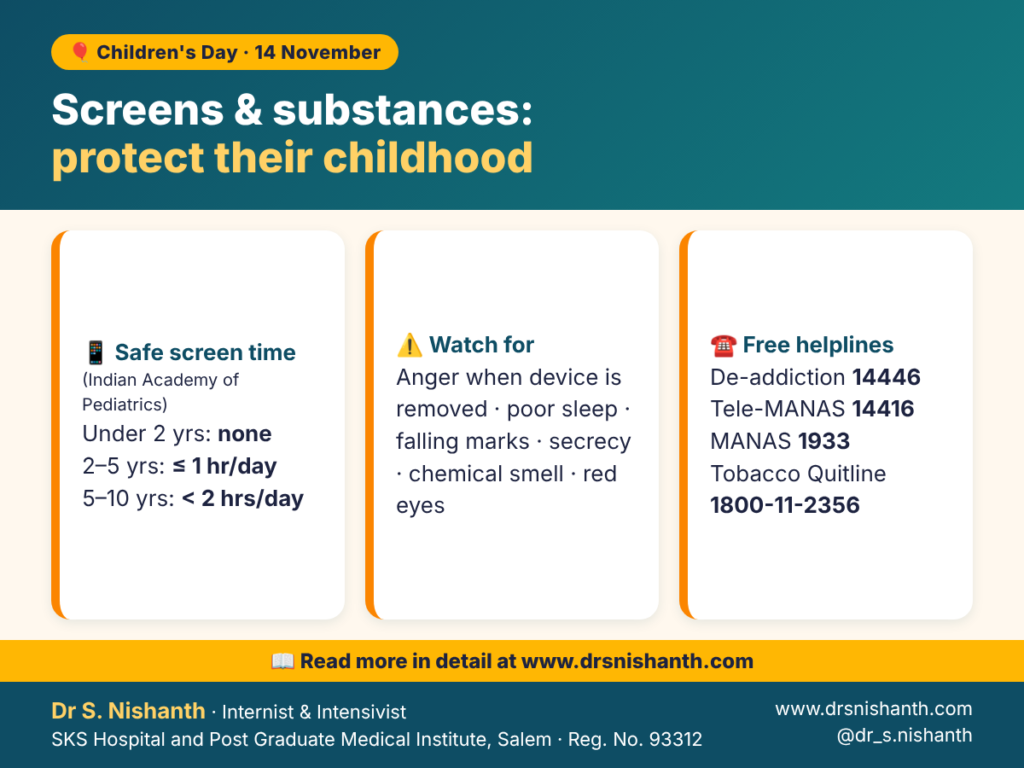
Short answer: No screens below 2 years, up to 1 hour a day for ages 2–5, and less than 2 hours a day for ages 5–10.
In detail: The Indian Academy of Pediatrics (IAP) guidelines on screen time and digital wellness give clear, age-wise advice:
Age Recommended recreational screen time
Below 2 years None (video calls with family are acceptable)
2 – 5 years Maximum 1 hour a day, always supervised by a parent
5 – 10 years Less than 2 hours a day
Adolescents Balance – screens must not replace sleep, physical activity, studies, meals, hobbies or family time
Similarly, the WHO guidelines for children under 5 advise very limited sedentary screen time for young children. Moreover, the IAP points out that very early exposure and more than 1–2 hours a day of screen time are already common among Indian children. As a result, preventing digital addiction in children has to start in the toddler years itself.
Q3. What are the warning signs of digital addiction in children?
Short answer: Anger when the device is taken away, poor sleep, falling marks, losing interest in play and friends, and hiding screen use.
In detail: Watch for these signs of digital addiction in children:
- Irritability, crying, or aggression when the phone or game is removed
- Gaming or scrolling late into the night, followed by tiredness in school
- Falling marks and poor concentration
- Giving up outdoor play, sports, hobbies and real-life friends
- Lying about or hiding screen time
- Physical effects – headaches, eye strain, neck and back pain, weight gain
- Repeated failed attempts to cut down
If several of these signs of digital addiction in children are present for weeks, it is time to act. Also, remember that excessive screens can hide anxiety, low mood or bullying, so a calm conversation is always the first step.
Q4. How does too much screen time harm a child’s health?
Short answer: It affects sleep, eyes, weight, posture, speech development in toddlers, attention, mood and school performance.
In detail: Firstly, screens before bedtime delay sleep, and poor sleep affects mood, memory and growth. Secondly, long hours of sitting reduce physical activity, which leads to obesity and, later, a higher risk of diabetes. (You can read more in my article on [INTERNAL LINK – sugar and high-carb diet article].) In addition, Indian studies have linked early screen exposure in toddlers to delayed speech. Furthermore, violent or unsuitable content can increase aggression and anxiety. For these reasons, managing digital addiction in children is not only a behaviour issue – it is a health issue.
Q5. Is substance use really a problem among school children in India?
Short answer: Yes. Indian surveys show that many children start using tobacco, alcohol or inhalants by about 13 years of age.
In detail: The national survey by the Ministry of Social Justice and Empowerment (Magnitude of Substance Use in India, 2019) estimated that about 4.6 lakh children aged 10–17 years need help for harmful use of inhalants such as whitener, glue and petrol. Moreover, a recent nationwide AIIMS-led study of school students (National Medical Journal of India, 2025) found that the average age of first use was about 13 years, and inhalants were started earliest, at around 11 years. The same study showed that substance use in family members and friends strongly increased a child’s risk.
Interestingly, digital addiction in children and substance use often share the same roots – stress, loneliness, lack of supervision and peer pressure. Consequently, the parenting steps that protect against one also protect against the other.
Q6. What are the early signs that my child may be using substances?
Short answer: A chemical or smoke smell, red eyes, sudden mood changes, new friends, secrecy, missing money and falling school performance.
In detail: Look out for:
- Smell of tobacco, alcohol or chemicals (whitener, glue, petrol) on breath, clothes or handkerchiefs
- Stains on fingers, sleeves or handkerchiefs; empty whitener bottles or tubes
- Red eyes, slurred speech, drowsiness or unusual excitement
- Sudden change of friends, loss of interest in studies and hobbies
- Missing money or valuables at home; frequent lies
- Mood swings, anger and withdrawal from family
However, one sign alone does not prove substance use. Instead of accusing, stay calm, talk openly and seek professional help early.
Q7. What does the law say about tobacco and children?
Short answer: In India, selling tobacco to anyone under 18, or within 100 yards of any educational institution, is illegal.
In detail: Section 6 of the Cigarettes and Other Tobacco Products Act (COTPA), 2003 prohibits the sale of cigarettes and other tobacco products to minors and near schools and colleges. Therefore, parents, teachers and local communities can and should report such shops.
Q8. What can parents do today to prevent digital addiction in children and substance use?
Short answer: Connect daily, set clear screen rules, be a role model, talk about drugs early and seek help without delay.
In detail:
- Spend screen-free time together – even 30 minutes of daily play, a walk or a shared meal builds the bond that protects children.
- Set clear family rules – no screens in bedrooms, at meals, or for 1 hour before sleep. Also, use parental controls and keep devices in common areas.
- Be the role model – children copy what we do, not what we say. So put your own phone down first.
- Encourage outdoor play and sports – physical activity improves mood, sleep and confidence. Similarly, good food matters; see my [INTERNAL LINK – vegetarian protein article].
- Talk about drugs early and calmly – explain the dangers before friends or the internet do. Above all, listen without shouting.
- Know their friends – meet their friends and parents; stay connected with teachers.
- Seek help early – digital addiction in children and substance use are both treatable, and early help gives the best results.
Q9. Where can I get help?
Short answer: Whether it is digital addiction in children or substance use, talk to your doctor or paediatrician, or call one of these free national helplines.
Helpline Number
National De-addiction Helpline (Nasha Mukt Bharat) 14446
Tele-MANAS – free 24×7 mental health support 14416 / 1-800-891-4416
MANAS – National Narcotics Helpline (NCB) 1933
National Tobacco Quitline 1800-11-2356
Cyber Crime / cyberbullying 1930
A Children’s Day message
Finally, the greatest gift we can give our children is not the latest gadget – it is our time, attention and example. Let us make this Children’s Day the day we start fighting digital addiction in children, and the day we begin open, loving conversations about drugs at home.
Disclaimer: This article is for general awareness only and is not a substitute for a medical consultation.
References
- Gupta P, Shah D, Bedi N, et al. Indian Academy of Pediatrics Guidelines on Screen Time and Digital Wellness in Infants, Children and Adolescents. Indian Pediatr. 2022;59(3):235–244. https://www.indianpediatrics.net/mar2022/235.pdf
- Indian Academy of Pediatrics. Screen Time Guidelines for Parents (2021). https://aha.iapindia.org//pdf/Guidelines-Screen-Time-Guidelines-for-Parents-Ch-005.pdf
- World Health Organization. Guidelines on Physical Activity, Sedentary Behaviour and Sleep for Children under 5 Years of Age. 2019. https://apps.who.int/iris/handle/10665/311664
- World Health Organization. ICD-11: 6C51 Gaming disorder. https://icd.who.int/
- Ministry of Social Justice and Empowerment, Govt. of India & NDDTC, AIIMS. Magnitude of Substance Use in India. 2019.
- Dhawan A, Chatterjee B, Bhargava R, et al. Substance use among school-going adolescents in India: Results from a nationwide survey. Natl Med J India. 2025;38:332–8. doi:10.25259/NMJI_824_2022
- The Cigarettes and Other Tobacco Products Act (COTPA), 2003 – Section 6.
- Narcotics Control Bureau – MANAS National Narcotics Helpline 1933. https://ncbmanas.gov.in
- Ministry of Health & Family Welfare – Tele-MANAS 14416; National Tobacco Quitline Services 1800-11-2356. https://ntqls.in