One Health AMR: Is Drug Resistance Only a Hospital Problem?
One Health AMR is a simple idea: antimicrobial resistance (AMR) cannot be stopped inside hospitals alone, because the health of people, animals, food, water and the environment is closely linked. Today, 18 November 2026, World AMR Awareness Week begins, and this year’s global theme is“One Health, one action: Prevent AMR now”. So, in this article, I answer the most common questions about One Health AMR in plain language.
By Dr S. Nishanth, MBBS, MD, DNB (General Medicine), MRCP (UK), FNB (Critical Care), EDIC, FECMO — Head – Department of Critical Care Medicine, SKS Hospital and Post Graduate Medical Institute, Salem | Reg. No. 93312
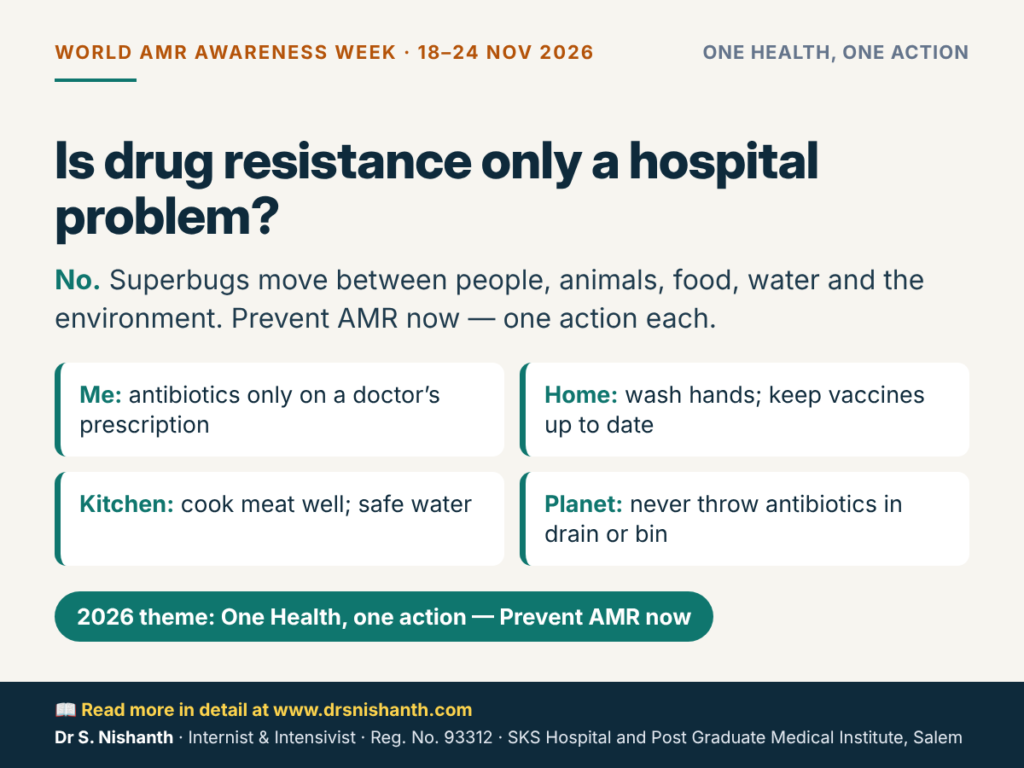
Is drug resistance only a hospital problem?No. Superbugs move between people, animals, food, water and soil. Therefore, One Health AMR prevention means that everyone — patients, families, farmers, pet owners and doctors — takes at least one action. The simplest actions are these: take antibiotics only on a doctor’s prescription, wash your hands, keep vaccines up to date, handle food safely, and never throw leftover antibiotics into the drain or the dustbin.
Antimicrobial resistance (AMR) happens when bacteria, viruses, fungi and parasites stop responding to the medicines meant to kill them. As a result, a simple infection can become hard, or even impossible, to treat.
Importantly, it is the germ that becomes resistant, not your body. Many people believe, “Antibiotics don’t work on me anymore.” In reality, the germs living in and around you have changed. Moreover, AMR is not limited to antibiotics; germs can also resist antivirals, antifungals and anti-parasite medicines.
What does One Health AMR mean?
One Health means that human health, animal health, plant health and the health of our environment are one connected system. Consequently, One Health AMR means looking at drug resistance across all of these areas together, instead of blaming only doctors or only patients.
For example, when antibiotics are overused on a poultry farm, resistant bacteria can reach us through meat, through farm workers, and through waste that flows into nearby water. Similarly, when we throw medicines into the drain, they reach rivers and soil, where bacteria get regular exposure and learn to survive. In short, One Health AMR reminds us that a superbug born in one place does not stay there.
How do superbugs travel from farms and the environment to my family?
There are four main routes, and each one is part of the One Health AMR picture:
People: First, taking antibiotics without a prescription, stopping the course early, or sharing leftover tablets gives germs the chance to adapt.
Animals: Second, giving antibiotics to healthy farm animals, only to make them grow faster, breeds resistant bacteria.
Food and water: Third, undercooked meat, unwashed vegetables and unsafe drinking water can carry these bacteria into our kitchens.
Environment: Finally, medicines thrown into drains and garbage, along with untreated waste, keep the cycle going.
After that, once a superbug enters a family, it can spread from person to person through unwashed hands and close contact.
The numbers are serious. According to the Global Research on Antimicrobial Resistance (GRAM) study published in The Lancet in 2024, AMR directly caused 1.14 million deaths worldwide in 2021. In addition, drug-resistant infections were involved in 4.71 million deaths that year. Furthermore, the same study expects about 39 million deaths directly due to AMR between 2025 and 2050 if we do not act.
Meanwhile, the World Health Organization (WHO) reported in 2025 that about one in six common bacterial infections worldwide already resist standard antibiotics, with South-East Asia among the most affected regions. That is why One Health AMR action is urgent, not optional.
What happens when AMR reaches the ICU?
As an intensivist, I see the end result of AMR every week. When the usual antibiotics fail, we have to use “last-line”drugs. These are often more expensive, may have more side effects, and sometimes still do not work. As a result, patients stay longer in the ICU, families face higher bills, and doctors have fewer choices.
However, the most important lesson from the ICU is this: prevention starts long before the patient reaches us. In fact, every antibiotic protected at home, on the farm or in the kitchen keeps a life-saving option open for the sickest patients — possibly someone in your own family. Therefore, One Health AMR is not a slogan for experts; it is a daily habit for all of us.
What can I do? One action for each part of One Health AMR
The 2026 theme asks each of us to take “one action”. Here is a simple One Health AMR checklist:
Me: Take antibiotics only when a qualified doctor prescribes them. Also, take the full dose for the number of days advised, and never share or save leftovers.
My home: Wash hands with soap and water, especially before eating and after using the toilet. In addition, keep vaccines up to date for children and the elderly, because fewer infections mean fewer antibiotics.
My kitchen: Cook meat and eggs well, wash fruits and vegetables, keep raw and cooked food apart, and drink safe water.
My pets and farm animals: Give antibiotics to animals only on a veterinarian’s advice, and never as growth boosters.
My planet: Do not throw antibiotics into the drain, toilet or dustbin. Instead, return unused or expired medicines to a pharmacy or a drug take-back point where one is available.
Above all, if you have a fever lasting more than 48 hours, see a doctor and get it investigated, rather than starting antibiotics on your own. For example, some fevers, such asdengue, are caused by viruses, so antibiotics will not help.
What is India doing about AMR?
India has taken several steps under the One Health AMR approach. For instance, the Ministry of Health and Family Welfare launched the National Action Plan on AMR 2.0 (2025–2029) on 18 November 2025. This plan brings human health, animal husbandry, agriculture, food safety and the environment together under one framework.
Earlier, in 2019, the government banned the antibiotic colistin — a last-resort drug for humans — for use in food-producing animals, poultry, aqua farming and animal feed supplements. Similarly, antibiotic strips that carry a vertical red line are prescription-only medicines; so, do not buy them without a prescription. Likewise, the Central Drugs Standard Control Organisation (CDSCO) has issued guidance on the safe disposal of unused and expired medicines, and it encourages drug take-back programmes.
Common questions about One Health AMR
Q: If I eat chicken, will I get superbugs?
A: Not necessarily. Eating well-cooked meat from trusted sources is safe. The risk comes mainly from undercooked meat and poor kitchen hygiene. So, cook thoroughly and keep raw meat away from ready-to-eat food.
Q: Can I flush leftover antibiotics down the toilet?
A: No. Antibiotics are not on the CDSCO list of medicines that may be flushed. Instead, return them to a pharmacy or a take-back point.
Q: My cold usually gets better with antibiotics. Should I take them again?
A: No. Most colds, coughs and sore throats are caused by viruses, and antibiotics do not kill viruses. In fact, the cold would have improved on its own. If a fever is part of the picture, read my article I Have a Fever. What Should I Do?
Q: How do vaccines help with AMR?
A: Vaccines prevent infections in the first place, so fewer people need antibiotics.
In summary, One Health AMR means that superbugs ignore the boundaries between hospitals, homes, farms and rivers, so our response must cross those boundaries too. This World AMR Awareness Week, pick one action today and share it with one person who still self-medicates.
For more health awareness articles, visit my articles page at www.drsnishanth.com.
Dr S. Nishanth, MBBS, MD, DNB (General Medicine), MRCP (UK), FNB (Critical Care), EDIC, FECMO — Head – Department of Critical Care Medicine, SKS Hospital and Post Graduate Medical Institute, Salem | Reg. No. 93312 | www.drsnishanth.com | Instagram: @dr_s.nishanth
This article is for general awareness only and does not replace a consultation with your doctor.
World Health Organization. World AMR Awareness Week 2026 — “One Health, one action: Prevent AMR now”. https://www.who.int/campaigns/world-amr-awareness-week/world-amr-awareness-week-2026
World Health Organization. Antimicrobial resistance — fact sheet. https://www.who.int/news-room/fact-sheets/detail/antimicrobial-resistance
GBD 2021 Antimicrobial Resistance Collaborators. Global burden of bacterial antimicrobial resistance 1990–2021 with forecasts to 2050. The Lancet, 2024. Summary: https://www.healthdata.org/antimicrobial-resistance/infographics
Food and Agriculture Organization of the United Nations. World AMR Awareness Week 2026. https://www.fao.org/antimicrobial-resistance/world-antimicrobial-awareness-week-2026/en/
Ministry of Health and Family Welfare, Government of India. National Action Plan on Antimicrobial Resistance 2.0 (2025–2029), launched 18 November 2025 (report: Down To Earth). https://www.downtoearth.org.in/health/waaw-2025-indias-much-awaited-second-version-of-the-national-action-plan-on-amr-released
Ministry of Health and Family Welfare, Government of India. Gazette notification prohibiting colistin for food-producing animals, poultry, aqua farming and animal feed supplements, July 2019 (report: The Week). https://www.theweek.in/news/health/2019/07/22/Sale-of-antibiotic-Colistin-for-food-producing-animals-banned.html
Central Drugs Standard Control Organisation. Guidance Document on Disposal of Expired/Unused Drugs, 2025 (report: Business Standard). https://www.business-standard.com/health/cdsco-lists-17-drugs-safe-to-flush-as-part-of-disposal-guidelines-125053001862_1.html
Pan American Health Organization. World Antimicrobial Resistance Awareness Week 2026. https://www.paho.org/en/campaigns/world-antimicrobial-resistance-awareness-week-2026