Men’s Mental Health: Why Men Hide Their Distress (and How Families Can Help)
Article:
Happy International Men’s Day! Today, 19 November, is a good day to talk openly about men’s mental health. Many men quietly carry stress, sadness and worry, yet they rarely say so. This year’s theme, “The Future Is Everyone”, reminds us that a healthy future needs men who are well in both body and mind.
Q1. What is men’s mental health, and why does it matter?
Short answer: Men’s mental health means how a man thinks, feels and copes with daily life. It matters because men often suffer silently, and many reach help too late.
Mental health is just as real as heart health or sugar control. In fact, stress, depression and anxiety affect sleep, blood pressure, work and family life. In India, nearly 3 out of 4 suicide deaths are men, according to the National Crime Records Bureau (NCRB) report for 2023. Moreover, behind each number is a family. For this reason, men’s mental health is not a “personal weakness” topic; it is a public health topic.
Q2. Why do men hide their distress?
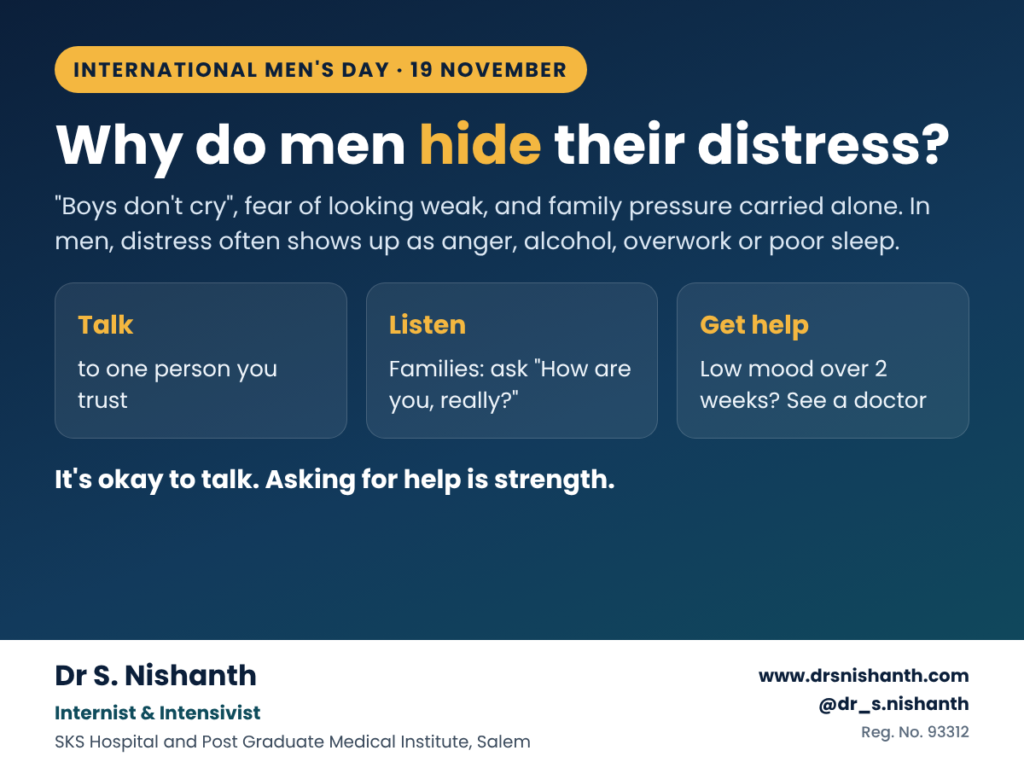
Short answer: Most men are taught from childhood to stay strong, stay quiet and solve problems alone. So they hide pain to avoid looking weak.
Here are the most common reasons:
- “Boys don’t cry”: Many of us grew up hearing this. As a result, men learn to hold feelings in rather than name them.
- Fear of looking weak: A man may worry that his family, friends or colleagues will respect him less if he admits he is struggling.
- Provider pressure: Money, job security, loans and family duties often rest on one man’s shoulders. Therefore, he may feel he has no “right” to break down.
- Stigma: Words like “mental” still carry shame. Consequently, many men avoid a doctor even when they know something is wrong.
- Not knowing the signs: Often, men simply do not recognise that what they feel is depression or anxiety.
Furthermore, research supports this. A 2025 systematic review found that traditional masculinity norms, such as self-reliance and emotional control, reduce men’s willingness to seek mental health support.
Q3. How does poor men’s mental health look in real life?
Short answer: In men, distress often does not look like sadness. Instead, it shows up as anger, irritability, alcohol, overwork or physical complaints.
Watch for these signs, especially if they last more than two weeks:
- Anger, short temper or irritability over small things
- Drinking more alcohol, smoking more or using other substances
- Working very long hours to avoid thinking or going home
- Poor sleep, or sleeping too much
- Headaches, body aches, stomach problems or tiredness with no clear cause
- Pulling away from friends, family and things he used to enjoy
- Talking about feeling hopeless, trapped or like a burden
Similarly, families may notice a man becoming quiet, distant or “not himself”. In other words, these changes deserve attention, not criticism.
Q4. What can a man do for his own mental health?
Short answer: Talk to one trusted person, look after sleep and body, cut down on alcohol, and see a doctor if low mood lasts more than two weeks.
- Talk to someone. A friend, spouse, sibling or doctor. Saying it out loud often reduces the weight.
- Protect your sleep. Keep fixed sleep and wake times. Also, keep the phone away at bedtime.
- Move every day. For example, even a 30-minute brisk walk improves mood and sleep.
- Cut down on alcohol. Although alcohol feels like relief, it worsens low mood and sleep over time.
- Get a health check. Conditions like thyroid problems, diabetes and other long-term illnesses can affect mood too.
- Seek help early. Depression is a medical condition, and it is treatable with counselling, medicines or both.
Q5. How can families support men’s mental health?
Short answer: Ask gently, listen without judging, and help him take the first step towards help.
- Ask, “How are you, really?” and then give him time to answer.
- Above all, listen more than you advise. Avoid lines like “Be a man” or “Others have bigger problems”.
- Share the load at home and with money matters where possible.
- Offer to go with him to the doctor or to call a helpline together.
- Finally, teach boys early that feelings are normal and talking is strength.
Q6. When should someone get help urgently?
Short answer: Get help the same day if a man talks about ending his life, says goodbye, gives away belongings, or seems unsafe.
In that situation, do not leave him alone. Call Tele-MANAS on 14416 (or 1-800-891-4416). It is the Government of India’s free, confidential, 24×7 mental health helpline, available in many Indian languages. Alternatively, go to the nearest hospital emergency department.
Final message on men’s mental health
To sum up, men’s mental health is everyone’s business: the man himself, his family, his workplace and his doctor. Asking for help is a sign of strength, not weakness. On this International Men’s Day, check on the men in your life, and let them know it is okay to talk.
If you have questions about your health, you can read more about Dr S. Nishanth or see the health conditions we manage.
Dr S. Nishanth
MBBS, MD, DNB (General Medicine), MRCP (UK), FNB (Critical Care), EDIC, FECMO
Head – Department of Critical Care Medicine
SKS Hospital and Post Graduate Medical Institute, Salem
Reg. No. 93312 | www.drsnishanth.com | Instagram: @dr_s.nishanth
This article is for general awareness and does not replace a consultation with your doctor.
References
- National Crime Records Bureau (NCRB). Accidental Deaths & Suicides in India 2023. Ministry of Home Affairs, Government of India.
- Ministry of Health and Family Welfare. National Mental Health Programme and Tele-MANAS helpline (14416). Government of India.
- Men’s Mental Health Matters: The Impact of Traditional Masculinity Norms on Men’s Willingness to Seek Mental Health Support – A Systematic Review. American Journal of Men’s Health, 2025. PMC12117241.
- World Health Organization. Depressive disorder (depression) – Fact sheet.
- International Men’s Day. 2026 theme announcement: “The Future Is Everyone”.