Insulin Myths: Once Started, Is Insulin Lifelong? Is It Harmful
Article:
Insulin myths stop many people with diabetes from accepting a treatment that could protect them. In our wards and ICU, for example, we often meet patients who delayed insulin for months because they believed it was “for life” or that it would “spoil the kidneys”. As a result, their sugars stayed high and the real damage continued quietly. In this article, therefore, I answer the most common questions about insulin in simple language.
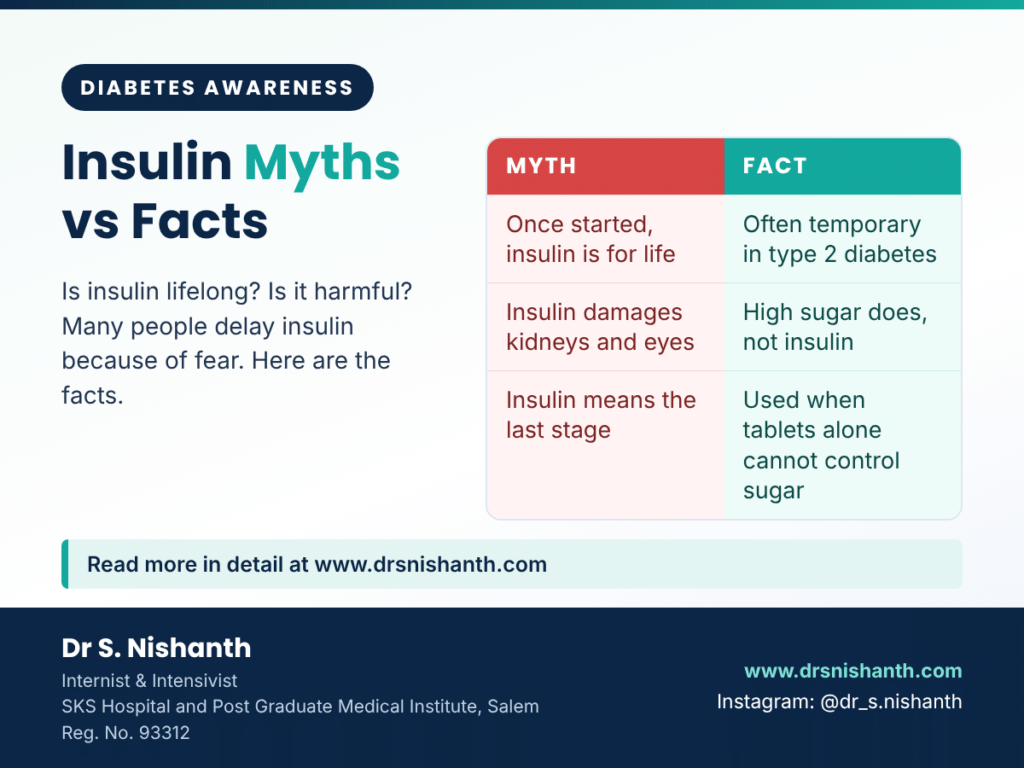
Short answer: Insulin is not always lifelong. Doctors often use it for a short time to bring very high sugars under control, for example during a serious infection, surgery, a hospital stay or pregnancy, and then step back to tablets. In long-standing type 2 diabetes, insulin is started only when the pancreas can no longer make enough insulin and tablets alone cannot control sugar. Insulin is a natural hormone. It does not damage your kidneys, eyes or heart; uncontrolled high sugar does.
Alt text:
What is insulin, and why do insulin myths matter?
Short answer: Insulin is a hormone that your own pancreas makes every day. Injected insulin simply replaces what the body is short of.
Insulin works like a key. After a meal, sugar enters the blood, and insulin then opens the “doors” of your muscle and liver cells so that sugar can go inside and be used for energy. In diabetes, either the body makes too little insulin, or the insulin does not work well, or both. Consequently, sugar builds up in the blood.
The insulin used in treatment is the same hormone (or a slightly modified form of it) made in a laboratory. In other words, it is not a foreign chemical. This is exactly why insulin myths matter: when people fear a natural hormone, they delay a safe treatment, and meanwhile the high sugar keeps harming the body.
Insulin myths #1: “Once I start insulin, I can never stop.” Is that true?
Short answer: Not always. It depends on the type of diabetes and the reason insulin was started.
In type 1 diabetes, the pancreas makes almost no insulin. Therefore, insulin is lifelong and life-saving. This is a different illness from the common type 2 diabetes.
In type 2 diabetes, however, insulin is often a temporary treatment. Doctors start it for a short period in situations such as:
- Very high sugar at diagnosis. When HbA1c is above 10% or blood sugar is 300 mg/dL or more, or when there is weight loss, thirst and frequent urination, guidelines recommend considering insulin first. Very high sugar itself “tires out” the pancreas (doctors call this glucotoxicity). Once insulin brings the sugar down, the pancreas often recovers some function.
- Serious infection, hospital admission or ICU stay. Illness and stress hormones push sugar up sharply. In hospital, insulin is the most reliable and safest way to control sugar, especially in critically ill patients. In fact, in our ICU almost every patient with high sugar receives insulin, including many who never had diabetes before.
- Surgery. Insulin keeps sugar steady before and after an operation, which helps wound healing and lowers infection risk.
- Steroid treatment. Steroids raise sugar, so insulin is used while the steroids continue.
- Pregnancy. In diabetes during pregnancy, insulin is the preferred and safe medicine for the baby. In gestational diabetes, it is usually stopped after delivery.
After the illness settles or the sugar is controlled, many people step back to tablets. Furthermore, studies show that a short course of intensive insulin (2 to 3 weeks) early in type 2 diabetes can improve the pancreas’s own insulin production. In some patients, it even gives a period of good control without any medicines. That said, this does not happen for everyone, and only your doctor can decide when and how to reduce insulin.
When do doctors start insulin long-term in type 2 diabetes?
Short answer: Only when the disease has reached a stage where the pancreas cannot make enough insulin, so that even the full dose of tablets cannot keep sugar on target.
Type 2 diabetes is a slowly progressive disease. Large studies, such as the UK Prospective Diabetes Study (UKPDS), showed that the insulin-making beta cells of the pancreas gradually lose function over the years. As a result, most people move step by step: first diet and exercise, then one tablet, then two or three tablets, and finally insulin.
Tablets mainly help the body use its own insulin better, or squeeze out a little more from the pancreas. Consequently, when the pancreas has very little insulin left to give, tablets simply have nothing to work with. At that point, insulin is the logical next step, and it is not a punishment.
So, the need for insulin reflects the natural course of the disease. Insulin did not cause it, and it does not mean the patient has “failed”. Indeed, understanding this one fact answers many insulin myths at once.
Insulin myths #2: “Insulin damages the kidneys, eyes and heart”
Short answer: False. High sugar damages these organs. Insulin protects them by controlling sugar.
This is probably the most harmful of all insulin myths. Many people say, “My relative started insulin and then went on dialysis.” However, the truth is the other way around. Often, insulin was started very late, after years of high sugar had already damaged the kidneys, eyes and nerves. Because the two events came close together, insulin was wrongly blamed.
In fact, good sugar control, whether with tablets or insulin, lowers the risk of kidney disease, eye damage and nerve damage. Insulin is also safe in kidney disease; indeed, doctors often prefer it when kidney function is low, because several tablets must be reduced or stopped.
Insulin myths #3: “My body will get addicted to insulin”
Short answer: No. Insulin is not a drug of addiction. It replaces a hormone your body needs but cannot make enough of.
The body does not become “used to” insulin the way it does with sleeping pills or alcohol. Similarly, nobody calls thyroid tablets addictive just because people with a weak thyroid need them every day. If your pancreas recovers or the illness passes, the insulin dose comes down. In contrast, if the pancreas has lost most of its function, insulin continues because the body truly needs it, not because of addiction.
Insulin myths #4: “Insulin injections are very painful”
Short answer: Most people are surprised at how little it hurts.
Modern insulin pens use very short, very thin needles, often only 4 to 6 mm long. Most patients say the injection hurts less than a finger-prick sugar test. In addition, injecting into the abdomen or thigh, changing the site each time and using a new needle make it even more comfortable. Your doctor, nurse or diabetes educator will teach you the technique, and after a few days it usually becomes routine.
Insulin myths #5: “Insulin means my diabetes is in the last stage”
Short answer: No. Insulin can be used at any stage, even at the time of diagnosis.
Current guidelines recommend considering insulin at any stage of type 2 diabetes when sugars are very high or symptoms appear. Thus, insulin is a treatment choice based on your sugar levels and your situation. It is not a sign that the end is near. Many people on insulin live long, active and healthy lives.
Does insulin have any side effects?
Short answer: Yes, mainly low sugar and mild weight gain. Unlike the insulin myths above, these effects are real; however, both can be managed with simple steps.
- Low sugar (hypoglycaemia): symptoms include sweating, shaking, a fast heartbeat, hunger, confusion or unusual behaviour. If this happens, first take 15 grams of fast sugar, for example 3 teaspoons of sugar or glucose in water, or half a glass of fruit juice. Then recheck your sugar after 15 minutes and repeat if it is still low. Once you feel better, eat a small snack. Moreover, tell your family how to recognise low sugar.
- Mild weight gain: this happens partly because sugar that was being lost in the urine is now used by the body. Regular meals, sensible portions and daily activity help to limit it.
Because of these effects, regular sugar checks and dose adjustment by your doctor are important.
Can I stop insulin on my own when my sugars become normal?
Short answer: No. Never stop or change insulin without talking to your doctor.
Among common insulin myths is the belief that normal readings mean the job is done. In reality, normal sugar readings on insulin usually mean the insulin is working, not that you no longer need it. Stopping it suddenly can cause the sugar to shoot up again. In some cases, it can even lead to a dangerous emergency called diabetic ketoacidosis. Instead, if your sugars are consistently normal or low, show your sugar records to your doctor, who will reduce the dose step by step or switch you back to tablets when it is safe.
When should I see a doctor urgently?
Short answer: Go to hospital immediately if very high sugar comes with vomiting, breathlessness or drowsiness, or if low sugar does not improve.
- Sugar persistently above 300 mg/dL, especially with vomiting, abdominal pain, fast breathing or drowsiness
- Repeated or severe low sugar episodes, confusion, fits or unconsciousness
- Fever or infection in a person with diabetes whose sugars are suddenly uncontrolled
The key message
Insulin myths cause delay, and delay causes damage. Insulin is a natural hormone and a safe, powerful tool. In type 2 diabetes, it is often temporary. When it is needed long-term, that is because the disease has progressed, not because insulin is harmful. So, if your doctor advises insulin, ask questions, clear your fears and start on time. Your kidneys, eyes, heart and nerves will thank you. Above all, share this article so that insulin myths stop harming the people you love.
Read also:
- Diabetes Explained: A Simple Guide for Everyone
- Reverse Prediabetes: How Much Sugar Hides in Your Tamil Nadu Plate?
- I Have a Fever. What Should I Do?
About the author
Dr S. Nishanth, MBBS, MD, DNB (General Medicine), MRCP (UK), FNB (Critical Care), EDIC, FECMO
Head – Department of Critical Care Medicine, SKS Hospital and Post Graduate Medical Institute, Salem
Reg. No. 93312 | www.drsnishanth.com | Instagram: @dr_s.nishanth
This article is for general awareness only and does not replace a consultation with your own doctor. Please do not start, stop or change any medicine without medical advice.
References
- American Diabetes Association Professional Practice Committee. 9. Pharmacologic Approaches to Glycemic Treatment: Standards of Care in Diabetes—2026. Diabetes Care. 2026;49(Suppl 1):S183–S215. https://doi.org/10.2337/dc26-S009
- American Diabetes Association Professional Practice Committee. 16. Diabetes Care in the Hospital: Standards of Care in Diabetes—2026. Diabetes Care. 2026;49(Suppl 1). https://doi.org/10.2337/dc26-S016
- American Diabetes Association Professional Practice Committee. 15. Management of Diabetes in Pregnancy: Standards of Care in Diabetes—2026. Diabetes Care. 2026;49(Suppl 1). https://doi.org/10.2337/dc26-S015
- Marrison ST, Bragg S, Tran E. Type 2 Diabetes: Outpatient Insulin Management. Am Fam Physician. 2026;113(6):542–550. https://www.aafp.org/afp/2026/0600/type-2-diabetes-insulin-management
- Weng J, Li Y, Xu W, et al. Effect of intensive insulin therapy on beta-cell function and glycaemic control in patients with newly diagnosed type 2 diabetes: a multicentre randomised parallel-group trial. Lancet. 2008;371:1753–1760. https://pubmed.ncbi.nlm.nih.gov/18502299/
- Kramer CK, Zinman B, Retnakaran R. Short-term intensive insulin therapy in type 2 diabetes mellitus: a systematic review and meta-analysis. Lancet Diabetes Endocrinol. 2013;1(1):28–34. https://journalclub.wustl.edu/2014/03/14/short-term-intensive-insulin-therapy-in-type-2-diabetes-mellitus-a-systematic-review-and-meta-analysis/
- UK Prospective Diabetes Study Group. UKPDS 16: Overview of 6 years’ therapy of type II diabetes: a progressive disease. Diabetes. 1995;44(11):1249–1258. https://doi.org/10.2337/diab.44.11.1249
- Fonseca VA. Defining and characterizing the progression of type 2 diabetes. Diabetes Care. 2009;32(Suppl 2):S151–S156. https://pmc.ncbi.nlm.nih.gov/articles/PMC2811457/
- Department of Community Medicine, Maulana Azad Medical College. Myths about diabetes and its treatment in North Indian population (cross-sectional study, PubMed Central). https://www.ncbi.nlm.nih.gov/pmc/articles/PMC2822217/