Tablets During Fasting: Safe Medicine Rules for the Sabarimala Vratham
Should you keep taking your tablets during fasting for the Sabarimala vratham? The short answer is yes. Fasting changes your food, but it does not change your need for medicines. Only your doctor should change the dose or the timing of a tablet, and you should never stop one on your own.
Every year, the Tamil month of Karthigai brings lakhs of devotees into the 41-day Mandala vratham. Many of them also live with high BP, diabetes or heart disease. At the same time, the season ends with a steep uphill trek from Pampa to Sannidhanam. In fact, the Kerala health department reports that most cardiac emergencies happen during this uphill climb. That is why getting your tablets during fasting right is not a small matter; it is a safety matter.
Can I stop my tablets during fasting for the vratham?
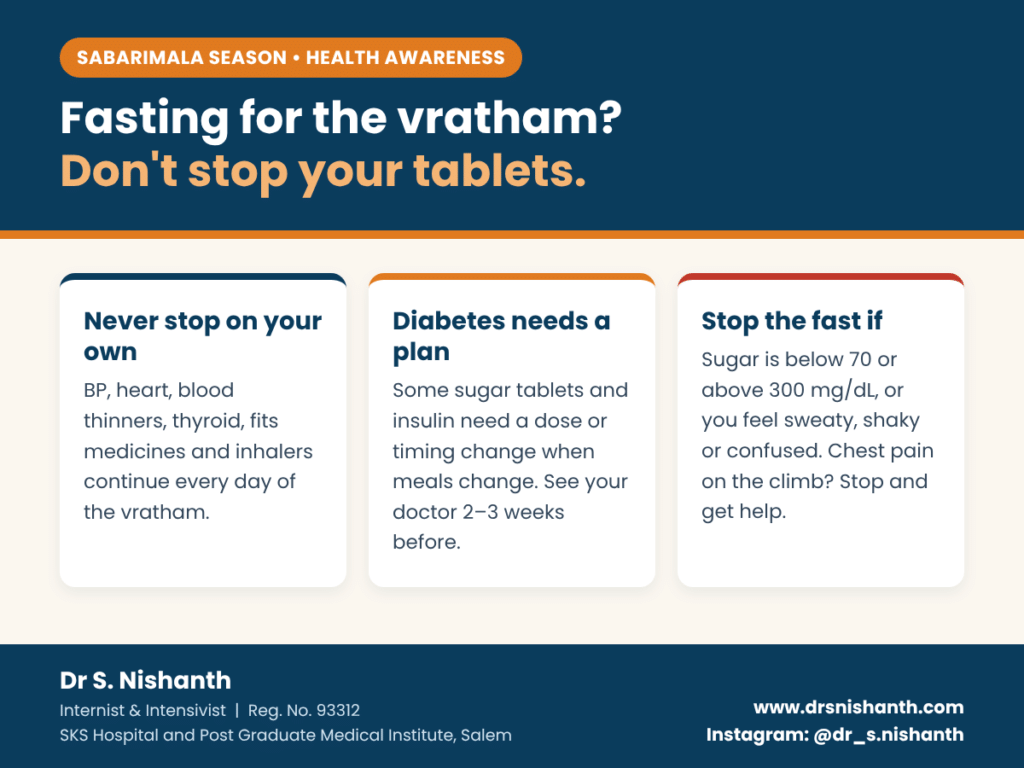
Short answer: No. The vratham is a discipline of food, habits and conduct. It is not a rule against medicines. Therefore, the safe approach is to continue your medicines and, if needed, let your doctor adjust them to your new eating pattern.
Many patients believe that a few weeks without tablets will “rest” the body. However, BP, diabetes and heart disease are controlled by medicines, not cured by them. So, when a tablet stops, the disease comes back, often suddenly. I have explained this in detail in my earlier article, Can I stop my BP or sugar tablets once the readings are normal?.
Which tablets during fasting must never be stopped?
These tablets during fasting do not depend on how much you eat. Because of this, they should continue every day of the vratham and on the day of the climb:
- BP tablets – stopping them suddenly can push the BP up sharply, and the climb pushes it up further.
- Heart medicines and blood thinners – for example aspirin, clopidogrel and other anti-clotting tablets. If you have a stent, missing these can cause the stent to block, which is a medical emergency.
- Cholesterol tablets (statins) – they protect the heart arteries. See my guide on the lipid profile to understand why.
- Thyroid tablets – take them as usual, on an empty stomach in the morning, with water.
- Fits (epilepsy) medicines – even one missed dose can trigger a fit. Moreover, long night travel and poor sleep on the pilgrimage also lower the fit threshold. Read my seizure first aid guide as well.
- Asthma and COPD inhalers – carry your reliever inhaler on the climb.
In addition, if you take a water tablet (diuretic) for BP or heart failure, heavy sweating on the trek can make you dehydrated and giddy. Even so, do not stop it yourself. Instead, ask your doctor whether the dose should change during the pilgrimage.
How do diabetes tablets during fasting need to change?
Diabetes is the condition where fasting needs the most planning. This is because the medicine keeps working even when the food stops coming. As a result, the sugar can fall too low (hypoglycaemia). On the other hand, a large single meal at night can push the sugar too high. The International Diabetes Federation lists low sugar, high sugar and dehydration as the main risks of fasting with diabetes.
Which diabetes tablets during fasting carry the most risk?
- Insulin – the dose usually needs to be reduced or re-timed when meals are skipped. Read my article on insulin myths if you are worried about insulin itself.
- Sulfonylurea tablets such as glimepiride, gliclazide and glibenclamide – these push the pancreas to release insulin, so they can cause low sugar when you eat less.
- SGLT2 inhibitor tablets such as dapagliflozin and empagliflozin – these pass sugar out in the urine, so together with fasting and a long trek they can cause dehydration.
- Metformin – it rarely causes low sugar by itself; however, its timing may still need to match your meals.
For this reason, meet your doctor two to three weeks before the vratham begins. Tell the doctor exactly how you plan to fast, for example one meal a day, fruit only in the daytime, or no food until evening pooja. Then the doctor can make a personal plan for your tablets during fasting. Indian diabetes experts have published practical guidance on managing diabetes medicines during Hindu fasts, and it follows the same principle: adjust, do not abandon.
When must I break the fast immediately?
International fasting guidelines from the IDF and the Diabetes and Ramadan Alliance give clear limits, and they apply equally to any religious fast. So, while you take diabetes tablets during fasting, break the fast at once if:
- your blood sugar is below 70 mg/dL, or
- your blood sugar is above 300 mg/dL, or
- you feel sweaty, shaky, confused or unusually tired, or you have a racing heart.
What should I do if my sugar drops?
First, stop walking and sit down. Next, take something sweet at once, such as three teaspoons of sugar in water, a glass of fruit juice or glucose tablets. Then check the sugar again after 15 minutes and repeat if it is still low. Finally, eat a proper meal once you feel better. Above all, always carry glucose or sugar with you during the vratham and on the trek.
How do I time my tablets during fasting if I eat only once a day?
Here are some simple rules for tablets during fasting to discuss with your doctor:
- Once-daily tablets for BP, thyroid or cholesterol can usually be taken at the same time every day, with water.
- Water is generally allowed during the vratham, so taking tablets with water does not break the fast.
- Tablets marked “after food” for diabetes may need to move to your one meal; however, only your doctor should decide this.
- Never take two doses together to “catch up” on a missed dose.
- Keep a written list of your tablets, doses and new timings.
Who should see a doctor before the vratham and the climb?
Similarly, some people need a check-up before they climb, not only a medicine plan. The Kerala health department also advises devotees with chronic illness to get a health check before the pilgrimage. See your doctor first if you:
- have heart disease, a stent, a past heart attack or bypass surgery,
- have diabetes that is poorly controlled, or you have had low-sugar episodes recently,
- take insulin, or you have kidney disease,
- are above 40 and do not exercise regularly, or you get breathless on climbing stairs,
- have asthma, COPD or fits.
If you are new to diabetes, my simple guide to diabetes is a good place to start.
Checklist for tablets during fasting and on the Sabarimala trek
- Take all your regular tablets on the day of the climb.
- Carry two to three days of extra tablets, because travel delays are common.
- Keep medicines in a separate bag or pocket, not inside the irumudi, so you can reach them quickly.
- Carry a copy of your prescription and a list of your illnesses.
- Keep glucose or sugar, and enough drinking water, in hand.
- Practise walking for a few weeks before the trip, and climb slowly with rests.
Which warning signs on the climb should never be ignored?
Many pilgrims mistake heart pain for “gas”. Therefore, stop climbing at once and seek help if you have:
- chest pain, pressure or tightness, or pain in the arm, jaw or back,
- sudden breathlessness,
- giddiness, fainting or heavy sweating,
- a racing or irregular heartbeat.
The Kerala health department runs cardiology centres and emergency medical centres along the Pampa–Sannidhanam route. So, do not keep walking to reach the temple first. Instead, get help at the nearest centre, because in a heart attack every minute counts.
Common questions about tablets during fasting
Does taking medicine break the vratham?
The vratham is about discipline, devotion and conduct. Taking prescribed tablets during fasting is part of caring for the body that makes the pilgrimage. If you are unsure, speak to your Guruswamy and your doctor; most will agree that health comes first.
Can I stop my cholesterol tablet for just 41 days?
No. Statins are among the tablets during fasting that must continue, because they protect the heart arteries every day, and the climb is exactly the time your heart needs that protection.
My sugar is normal now. Can I skip my diabetes tablet while fasting?
Your sugar is normal because of the tablet. However, if you eat much less, the dose may need to come down. That is a decision for your doctor, not a reason to stop.
Key takeaways
- Continue your tablets during fasting; the vratham is about food, not medicines.
- Never stop BP, heart, blood thinner, thyroid, fits or asthma medicines on your own.
- Diabetes medicines and insulin need a doctor’s plan two to three weeks before the vratham.
- Break the fast if sugar is below 70 or above 300 mg/dL, or if you feel unwell.
- On the climb, chest pain is not “gas” – stop and get help.
This article is for general awareness only. Please do not start, stop or change any medicine without speaking to your own doctor.
Wishing every Ayyappa devotee a safe and blessed pilgrimage. Read more health guides at www.drsnishanth.com and follow me on Instagram at @dr_s.nishanth.
About the author
Dr S. Nishanth, MBBS, MD, DNB (General Medicine), MRCP (UK), FNB (Critical Care), EDIC, FECMO
Head – Department of Critical Care Medicine
SKS Hospital and Post Graduate Medical Institute, Salem
Reg. No. 93312
References
- Hassanein M, et al. Diabetes and Ramadan: Practical guidelines 2021 (IDF–DAR). Diabetes Res Clin Pract. 2022;185:109185. idf.org | doi.org/10.1016/j.diabres.2021.109185
- Kalra S, Bajaj S, Gupta Y, et al. Fasts, feasts and festivals in diabetes-1: Glycemic management during Hindu fasts. Indian J Endocrinol Metab. 2015;19(2):198–203. PMC4319259
- Gupta L, Khandelwal D, Singla R, Gupta P, Kalra S. Pragmatic dietary advice for diabetes during Navratris. Indian J Endocrinol Metab. 2017;21(1):231–237. PMC5240068
- International Diabetes Federation. Fasting and diabetes. idf.org/managing-diabetes/fasting
- Onmanorama. Sabarimala season: medical facilities for pilgrims (12 Nov 2026). onmanorama.com