Can I stop my BP or sugar tablets once the readings are normal
Control vs cure is the one idea every person on BP or diabetes tablets must understand. Many patients stop their blood pressure or sugar tablets as soon as the readings become normal, because they believe the disease has been cured. However, in most cases the readings are normal only because the tablets are working. This guide explains control vs cure in simple words, so that you can protect your heart, brain, kidneys and eyes.
Can I stop my BP or sugar tablets once the readings are normal?
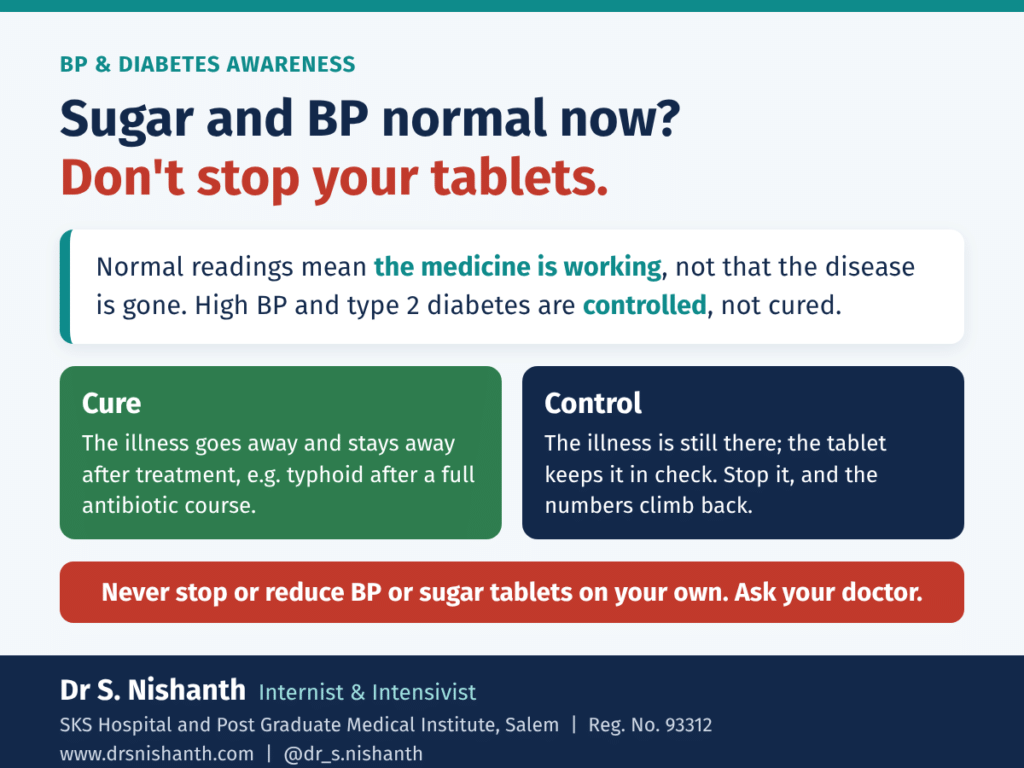
Short answer: No, not on your own. High blood pressure (hypertension) and type 2 diabetes are long-term conditions that can be controlled, but in most people they cannot be cured. A normal reading is proof that the treatment is working. In other words, it is not proof that the disease has gone. If you stop the tablets, the numbers usually rise again, often silently. Only your doctor should reduce or stop a dose, and only after checking your readings over time.
What does control vs cure actually mean?
To understand control vs cure, compare two kinds of illness.
- Cure: the illness goes away completely and does not come back after the treatment ends. For example, typhoid or pneumonia usually clears after a full course of the right antibiotic. Once you are cured, you no longer need the medicine.
- Control: the illness is still present inside the body, but the medicine keeps it in check. High BP, type 2 diabetes, high cholesterol and thyroid disorders belong to this group. As a result, the medicine has to continue for the control to continue.
A simple example makes control vs cure clear. When you hold an umbrella in the rain, you stay dry. Still, staying dry does not mean the rain has stopped. If you close the umbrella because you feel dry, you will get wet again. Similarly, your BP and sugar tablets are the umbrella, and the disease is the rain that keeps falling.
Why do BP and sugar become normal on tablets?
BP tablets work in different ways. For example, some relax the blood vessels, some remove extra salt and water, and some slow the heart. Diabetes tablets also act in several ways; for instance, they help the body use insulin better, make the liver release less sugar, or pass extra sugar out in the urine. However, none of these tablets removes the root cause. The tendency to high BP or high sugar comes from genes, age, weight, diet, activity and stress, and that tendency stays. Therefore, when the tablet’s effect wears off, the readings drift back up within days to weeks. This is the heart of control vs cure.
The World Health Organization notes that fewer than one in four people with hypertension have it under control. Stopping tablets once readings look normal is one of the common reasons for this gap.
What happens if I stop my tablets on my own?
Most people feel no change at first, and that is exactly why ignoring control vs cure is dangerous. High BP and high sugar usually cause no symptoms until damage has already happened. This is why they are called silent diseases.
- Uncontrolled BP can lead to stroke (paralysis), heart attack, heart failure and kidney damage.
- Uncontrolled sugar slowly damages the eyes, kidneys, nerves, feet and heart. Moreover, very high sugar can sometimes cause a life-threatening emergency that needs ICU care.
- Sudden stopping of some BP medicines can make the BP and heart rate shoot up quickly, which may trigger chest pain in people with heart disease.
- People with type 1 diabetes must never stop insulin, because they can become dangerously ill within hours to days.
As an intensivist, I regularly see patients admitted to the ICU with stroke, heart attack or a severe sugar emergency soon after they stopped their tablets because “everything was normal”. In fact, most of these admissions could have been prevented by simply continuing the medicine.
Control vs cure: can high BP or type 2 diabetes ever be reversed?
Sometimes, yes, but even then the right word is “remission”, not “cure”. Some people with type 2 diabetes who lose a good amount of weight can keep normal sugar levels without medicines. Experts from the American Diabetes Association define remission as an HbA1c below 6.5% for at least three months after stopping diabetes medicines. Even so, they advise continued follow-up, because sugar can rise again. Likewise, some people with high BP who reduce salt, lose weight, exercise and stop smoking may need fewer tablets.
The key point in control vs cure is this: any reduction must be planned by your doctor, step by step, with regular checks. You can learn more about lowering sugar through food in my article on reversing prediabetes with the Tamil Nadu plate.
Control vs cure: what should I do instead?
- Do not stop or reduce tablets on your own. Continue them even when you feel well.
- Keep a simple record. Note your home BP and sugar readings, and then show them to your doctor at each visit.
- Report low readings or side effects. For example, dizziness on standing, or low-sugar signs such as shaking, sweating or confusion, mean the dose may need adjusting. See your doctor rather than stopping the tablet yourself.
- Work on lifestyle. Less salt and sugar, regular walking, weight loss, good sleep and no tobacco all help. As a result, your doctor may be able to reduce your tablets safely.
- Keep your follow-up tests. HbA1c, kidney tests, cholesterol and eye checks pick up problems early. Also read my simple guide to the lipid profile.
Common questions about control vs cure
“I feel perfectly fine. Why should I take tablets?”
Because feeling fine is the usual state in high BP and diabetes. Symptoms often appear only after an organ is damaged. So the tablets protect you from what you cannot feel. That is control vs cure in daily life.
“Won’t long-term tablets damage my kidneys?”
In reality, uncontrolled BP and sugar are among the commonest causes of kidney failure. Your doctor checks your kidney function and chooses doses accordingly. In fact, some BP and diabetes medicines actively protect the kidneys.
“Can I take the tablet only when my reading is high?”
No, because that misunderstands control vs cure. These medicines work by keeping levels steady every day. Taking them on and off causes swings that strain the heart and blood vessels. Therefore, take them daily as prescribed.
“Can natural remedies replace my tablets?”
Diet and exercise are powerful, and they work best alongside your medicines. However, do not replace prescribed tablets with powders or remedies without speaking to your doctor first. If you are new to diabetes, my article Diabetes Explained: A Simple Guide for Everyone is a good place to start.
The bottom line on control vs cure
Once you understand control vs cure, the message is simple: normal readings mean your treatment is succeeding. Keep going, keep checking, and let your doctor decide when a dose can change. Finally, remember the umbrella: as long as the rain falls, keep it open. If you have questions about your own medicines, please contact me or speak with your treating doctor.
Dr S. Nishanth
MBBS, MD, DNB (General Medicine), MRCP (UK), FNB (Critical Care), EDIC, FECMO
Head – Department of Critical Care Medicine
SKS Hospital and Post Graduate Medical Institute, Salem
Reg. No. 93312 | www.drsnishanth.com | Instagram: @dr_s.nishanth
This article is for general awareness and does not replace advice from your own doctor.
References
- World Health Organization. Hypertension – Fact sheet. who.int
- World Health Organization. Guideline for the pharmacological treatment of hypertension in adults. Geneva: WHO; 2021. who.int
- World Health Organization. Global report on hypertension: the race against a silent killer. Geneva: WHO; 2023.
- Riddle MC, Cefalu WT, Evans PH, et al. Consensus report: definition and interpretation of remission in type 2 diabetes. Diabetologia. 2021;64(11):2359–2366. PubMed
- American Diabetes Association. International experts outline diabetes remission diagnosis criteria (press release, 30 Aug 2021). diabetes.org
- American Diabetes Association. Standards of Care in Diabetes (current edition). professional.diabetes.org
- Lean MEJ, Leslie WS, Barnes AC, et al. Primary care-led weight management for remission of type 2 diabetes (DiRECT). Lancet. 2018;391(10120):541–551.
- Burnier M, Egan BM. Adherence in hypertension: a review of prevalence, risk factors, impact, and management. Circ Res. 2019;124(7):1124–1140.
1 Comment