Is Broiler Chicken Safe? Hormone Myths, Antibiotics and Healthy Cooking
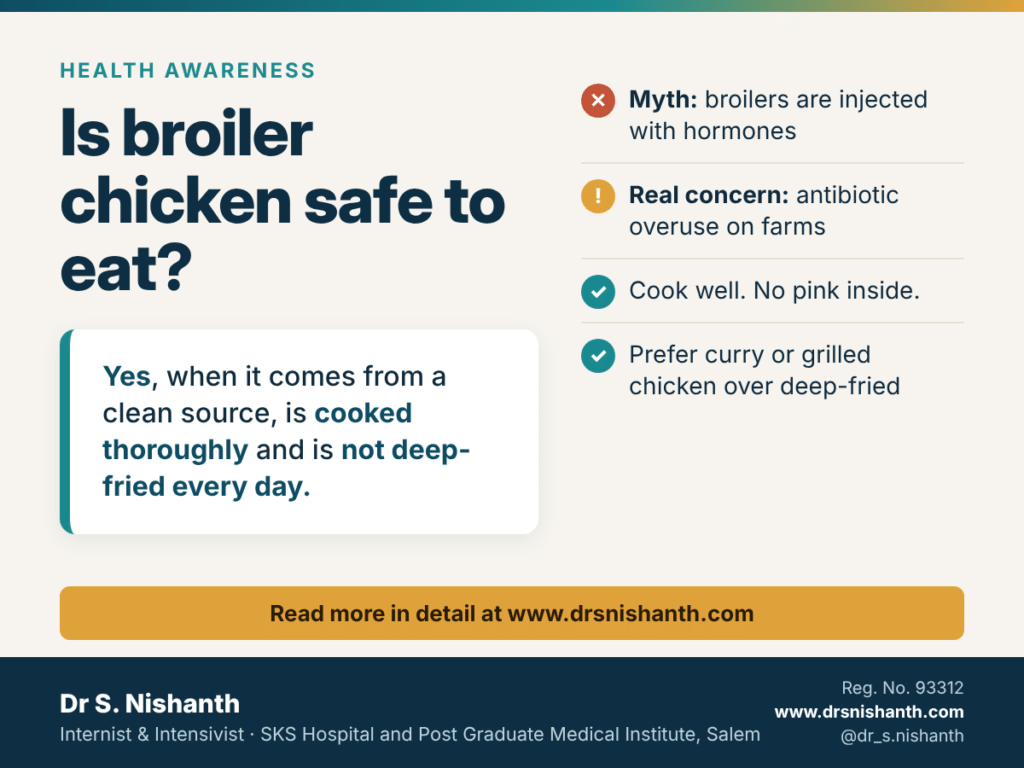
Is broiler chicken safe to eat? In short, yes. Broiler chicken is safe and nutritious when it comes from a clean source, is cooked thoroughly, and is not deep-fried every day. In fact, the real risks are not hormones but antibiotic overuse on farms, germs in raw chicken and unhealthy cooking methods.
By Dr S. Nishanth, MBBS, MD, DNB (General Medicine), MRCP (UK), FNB (Critical Care), EDIC, FECMO. Internist & Intensivist, Head – Department of Critical Care Medicine, SKS Hospital and Post Graduate Medical Institute, Salem. Reg. No. 93312.
Almost every week, a patient in my clinic asks me whether broiler chicken is safe for the family. Some have stopped eating it completely because of messages on WhatsApp. Others still eat it but feel guilty. So, in this article I answer the most common questions in simple language, with the evidence behind each answer.
1. Is broiler chicken safe to eat every week?
Short answer: Yes, for most healthy people, broiler chicken is safe to eat several times a week as part of a balanced diet.
Broiler chicken is simply a breed of chicken raised for meat. It is lean, affordable and rich in protein. For example, 100 g of cooked, skinless chicken breast gives about 31 g of protein and only about 3.6 g of fat. Moreover, large studies that followed people for many years found that eating poultry does not raise the risk of heart disease. In addition, people who replace red meat or processed meat with poultry tend to have better health outcomes. Therefore, broiler chicken is safe to include in your weekly meals, as long as the portion and cooking method are sensible.
2. Are broiler chickens injected with hormones?
Short answer: No. This is the most common myth about broiler chicken, and it is not true.
Broilers grow fast because of decades of selective breeding, balanced feed and better farm management. Also, injecting lakhs of birds one by one would be impractical and far too costly for farmers. Furthermore, growth hormone is a protein, so if it were given in feed, the bird’s gut would simply digest it like any other protein. Similarly, in countries such as the USA, no hormones are approved for growth in poultry at all. As a result, the fear that broiler chicken causes early puberty or hormone problems is not supported by evidence. In other words, on the question of hormones, broiler chicken is safe.
3. If not hormones, what is the real concern with broiler chicken?
Short answer: The real concern is the overuse of antibiotics on some poultry farms, which breeds drug-resistant germs.
Some farms have used antibiotics not only to treat sick birds but also to make healthy birds grow faster. For instance, a 2014 study by the Centre for Science and Environment (CSE) tested 70 chicken samples from Delhi-NCR and found antibiotic residues in 40% of them. More importantly, this overuse helps bacteria become resistant to medicines. These drug-resistant germs can then spread to people through food, hands, water and soil. I have explained this “One Health” link in detail in my article One Health AMR: Is Drug Resistance Only a Hospital Problem?
However, the rules have become stricter. In 2019, India banned colistin, a last-resort antibiotic for humans, in food-producing animals and poultry. In addition, FSSAI has set tolerance limits for antibiotic residues in meat and poultry, and it has tightened these limits further from April 2025. So, the situation is improving, although enforcement still matters. Meanwhile, as a consumer, you can choose clean, licensed shops and trusted brands.
4. Can raw broiler chicken make me sick?
Short answer: Yes, raw or undercooked chicken can cause food poisoning. However, thorough cooking makes broiler chicken safe.
Raw chicken can carry bacteria such as Salmonella and Campylobacter. These germs cause vomiting, loose stools, abdominal pain and fever. Fortunately, they are killed when chicken is cooked to a core temperature of about 74°C (165°F). Similarly, WHO and FAO state that properly cooked poultry is safe to eat even during bird flu outbreaks, because cooking at 70°C or above in all parts of the meat inactivates the virus. If you develop a fever after food poisoning, my guide I Have a Fever. What Should I Do? explains when to see a doctor. Also, please do not take antibiotics on your own for loose stools; read Antibiotic Misuse: Do You Really Need an Antibiotic for That Fever? to know why.
5. How do I keep broiler chicken safe in my kitchen?
Short answer: Buy clean, keep it cold, avoid cross-contamination and cook it fully.
- Buy from a clean, licensed shop. Then refrigerate the chicken as soon as you reach home.
- Use a separate board and knife for raw chicken. Afterwards, wash your hands with soap for at least 20 seconds.
- Do not rinse it under a running tap. Washing does not remove germs; instead, it splashes them onto the sink and nearby food. Cooking, not washing, makes broiler chicken safe.
- Cook it fully. In other words, no pink meat should remain near the bone, and the juices should run clear.
- Refrigerate leftovers within 2 hours, and then reheat them until they are steaming hot.
6. Does the way I cook broiler chicken matter?
Short answer: Yes. In fact, the cooking method often matters more than the chicken itself.
When any meat, including chicken, is grilled over an open flame, deep-fried or charred, chemicals called heterocyclic amines (HCAs) and polycyclic aromatic hydrocarbons (PAHs) are formed. According to the US National Cancer Institute, frequent intake of well-done, fried or barbecued meat has been linked to a higher risk of some cancers. On the other hand, boiling, stewing and curry-style cooking at around 100°C produce only negligible amounts of these chemicals. Besides, deep frying adds a lot of oil and calories, especially when the oil is reused.
- Choose more often: chicken kuzhambu, pepper chicken, chicken stew, clear soup, or grilled chicken that is not charred.
- Limit: chicken 65, fried chicken, and charred tandoori or barbecue chicken.
- Remove the skin to cut down on saturated fat. This is especially useful if your cholesterol is high. See Lipid Profile Explained.
7. Is country chicken (nattu kozhi) safer than broiler chicken?
Short answer: Both are good sources of protein. Country chicken is not automatically “safer”. Broiler chicken is safe too, if you buy it from a clean source and cook it well.
Country chicken is usually leaner and firmer, and many families prefer its taste. Nevertheless, both kinds can carry germs if they are handled poorly, and both are safe once cooked properly. Ultimately, hygiene, cooking and portion size matter far more than the breed of bird. Likewise, if you are vegetarian, you can meet your protein needs without chicken; see Can Vegetarians Get Enough Protein?
8. Who should be more careful with chicken?
Short answer: Broiler chicken is safe for most people. However, a few groups should take extra care.
- Pregnant women, young children, older adults and people with low immunity should eat chicken only when it is fully cooked, because food poisoning can be more serious for them.
- People with kidney disease may need to limit their total protein intake, so please ask your doctor how much protein is right for you.
- People with gout should also keep their meat portions moderate.
Key takeaway: broiler chicken is safe when handled well
To sum up, broiler chicken is safe, affordable and a good source of protein. Firstly, the hormone story is a myth. Secondly, antibiotic overuse on farms is a real concern, but regulations are improving. Finally, at home, clean handling, thorough cooking and healthier recipes make the biggest difference. So, you do not need to stop eating chicken; instead, eat it the right way.
This article is for general awareness only and is not a substitute for personal medical advice. If you have a medical condition, please consult your doctor about your diet.
References
- Mississippi State University Extension. Chickens Do Not Receive Growth Hormones: So Why All the Confusion? (P2767)
- Centre for Science and Environment. Latest study by CSE’s Pollution Monitoring Lab finds antibiotic residues in chicken. 2014.
- Ministry of Health and Family Welfare, Government of India. Prohibition of colistin and its formulations for food-producing animals, poultry, aqua farming and animal feed supplements. Notification, 19 July 2019. News report.
- Food Safety and Standards Authority of India. Food Safety and Standards (Contaminants, Toxins and Residues) Regulations: tolerance limits for antibiotics and veterinary drugs. Summary (Down To Earth).
- Centers for Disease Control and Prevention. Chicken and Food Poisoning.
- FAO/WHO. No bird flu risk for consumers from properly cooked poultry and eggs. December 2005.
- National Cancer Institute. Chemicals in Meat Cooked at High Temperatures and Cancer Risk.
- WHO / IARC. Carcinogenicity of the consumption of red meat and processed meat: Q&A. 2015.
- Papp RE, et al. Association of poultry consumption with cardiovascular diseases and all-cause mortality: a systematic review and dose-response meta-analysis. Crit Rev Food Sci Nutr. 2021.
- Lupoli R, et al. White Meat Consumption, All-Cause Mortality, and Cardiovascular Events: A Meta-Analysis of Prospective Cohort Studies. Nutrients. 2021.
- USDA FoodData Central. Chicken, broilers or fryers, breast, meat only, cooked, roasted (FDC ID 171477).
Dr S. Nishanth
MBBS, MD, DNB (General Medicine), MRCP (UK), FNB (Critical Care), EDIC, FECMO
Internist & Intensivist | Head – Department of Critical Care Medicine
SKS Hospital and Post Graduate Medical Institute, Salem
Reg. No. 93312 | www.drsnishanth.com | Instagram: @dr_s.nishanth