Ultra-Processed Foods: Are Packaged Snacks Harming Your Health?
Ultra-processed foods are now part of almost every home in Tamil Nadu: the biscuit with morning tea, the packet of chips in the evening, instant noodles for a quick dinner and a cold drink at every function. Because tomorrow, 26 November, is Anti-Obesity Day in India, today is the right moment to ask a simple question. What are ultra-processed foods really doing to our health, and what can an ordinary family do about it?
Quick answer: are ultra-processed foods bad for health?
Short answer: Yes, when they are eaten every day. Ultra-processed foods are factory-made products built mainly from refined flour, sugar, oil, salt and additives. In addition, large studies link a high intake to obesity, type 2 diabetes, heart disease, some cancers, depression and early death. An occasional treat is fine; however, the daily habit is the real problem. Fresh, home-cooked food remains the safest choice.
What exactly are ultra-processed foods?
Short answer: Simply put, they are industrial formulations with long ingredient lists, often containing things you would never use in your own kitchen.
To begin with, scientists commonly use the NOVA classification, which sorts food into four groups by how much it has been processed. In other words, the question is not “Was this food processed?” but “How far was it changed from its natural form?”
| NOVA group | What it means | Everyday examples |
|---|---|---|
| 1. Unprocessed or minimally processed | Natural food, only cleaned, cut, dried, boiled or fermented | Rice, dal, vegetables, fruits, milk, curd, eggs, fresh fish and meat, home-made idli batter |
| 2. Culinary ingredients | Used in small amounts to cook group 1 foods | Oil, ghee, salt, sugar, jaggery |
| 3. Processed foods | Group 1 food with salt, sugar or oil added | Paneer, cheese, pickles, canned vegetables, simple bakery bread |
| 4. Ultra-processed foods | Factory formulations with additives such as colours, flavours, emulsifiers and sweeteners | Chips, biscuits, instant noodles, cold drinks, packaged juices, sugary cereals, sausages, nuggets, bakery puffs, packaged sweets, “health drink” powders |
Is all processed food unhealthy?
Short answer: No. Curd, home-made dosa batter, frozen peas and paneer are processed, yet they are perfectly healthy.
Clearly, processing itself is not the enemy. In fact, cooking, drying and fermenting have kept food safe for centuries. The concern is mainly with group 4, the ultra-processed foods, because they are engineered to taste very good, last for months on a shelf and be eaten quickly in large amounts.
Which ultra-processed foods are common in Tamil Nadu?
Short answer: In general, most of the packets in a typical petty shop or supermarket snack aisle.
- Cream biscuits, “digestive” biscuits and rusk
- Chips, packaged mixture and murukku made with hydrogenated fat
- Instant noodles and ready-to-eat soups
- Cold drinks, energy drinks and packaged fruit juices
- Bakery puffs, cakes, buns and pastries
- Chocolate, ice cream and flavoured yoghurt
- Sausages, nuggets, salami and other processed meats
- Sweetened breakfast cereals and malted “health drink” powders
How do ultra-processed foods harm the body?
Short answer: They make us eat more calories, they are loaded with sugar, salt and unhealthy fat, and they push fresh food off the plate.
They make us overeat without noticing
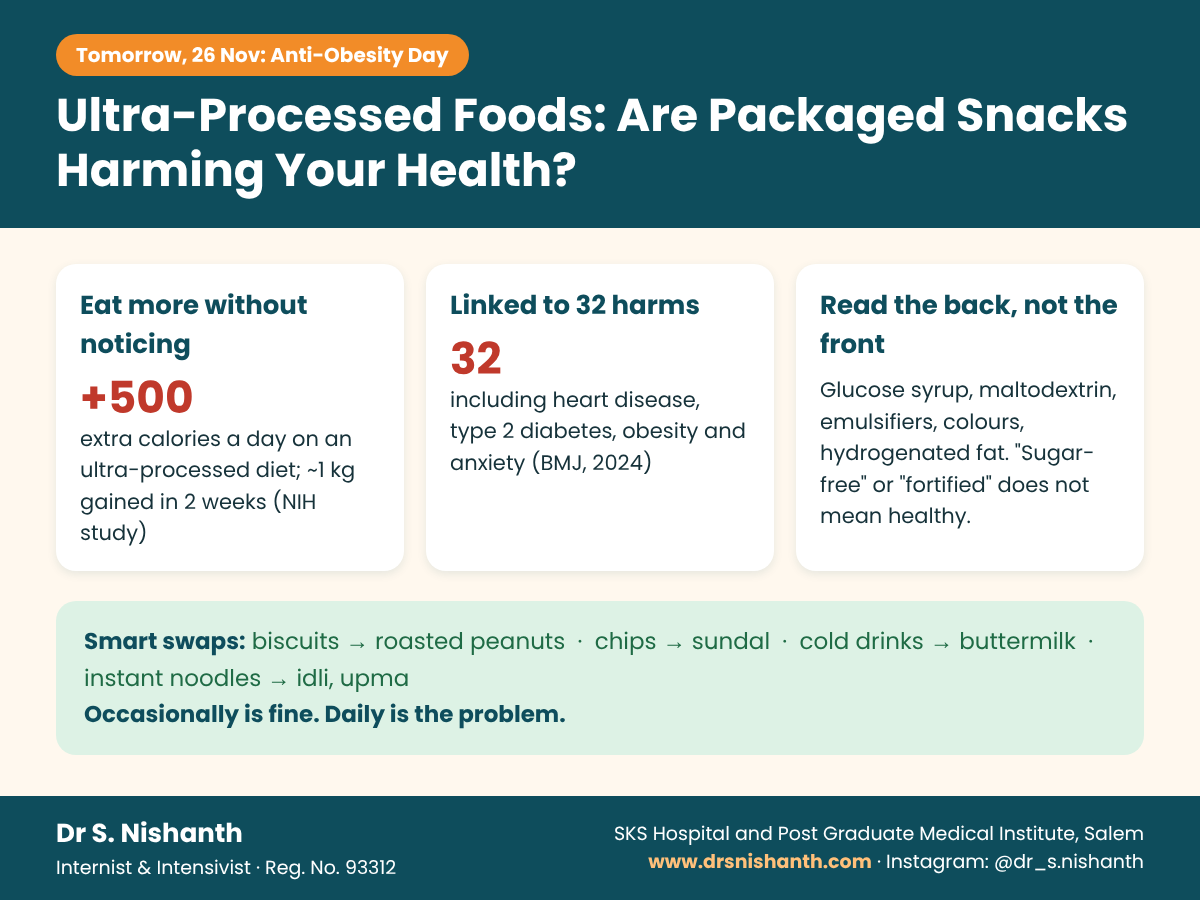
In a carefully controlled study at the US National Institutes of Health, adults ate either an ultra-processed diet or an unprocessed diet for two weeks each. On the ultra-processed diet, they ate about 500 extra calories every day and gained close to 1 kg in just two weeks. As a result, weight gain becomes almost automatic when ultra-processed foods become the main diet.
Too much sugar, salt and unhealthy fat
Above all, many ultra-processed foods are high in added sugar, sodium and saturated or trans fat. Consequently, they raise blood sugar, blood pressure and cholesterol. If you are already watching your sugar, our guide on how much sugar hides in your Tamil Nadu plate explains this in detail.
Low in fibre, protein and nutrients
Meanwhile, these foods are usually low in fibre, protein, vitamins and minerals. Therefore, you feel hungry again soon after eating them. Similarly, a child who fills up on biscuits and juice has little appetite left for dal, vegetables and fruit.
Processed meat and cancer
The World Health Organization’s cancer agency (IARC) classifies processed meat, such as sausages, ham and salami, as a cause of cancer in humans. For example, eating 50 g of processed meat every day raises the risk of colorectal (bowel) cancer by about 18%.
Additives, packaging and the gut
At the same time, researchers are also studying how certain emulsifiers, sweeteners and packaging chemicals may affect gut bacteria and inflammation. Although this evidence is still developing, it is one more reason to prefer fresh food. Our article on microplastics and your health covers the packaging side.
What does the research say about ultra-processed foods and disease?
Short answer: In short, the evidence is now large and consistent.
- The BMJ, 2024: A review covering almost 10 million people linked ultra-processed foods to 32 harmful health outcomes. For instance, high intake was associated with about 50% higher risk of death from heart disease, 12% higher risk of type 2 diabetes, higher risk of anxiety and common mental disorders, and 21% higher risk of death from any cause.
- The Lancet, November 2025: A three-paper series by 43 international experts, including researchers from India, concluded that ultra-processed foods are replacing traditional diets worldwide and driving chronic disease.
- WHO and ICRIER, India, 2023: Retail sales of ultra-processed foods in India grew by about 13% every year between 2011 and 2021, with beverages, confectionery and ready-made foods leading the rise.
- ICMR-NIN Dietary Guidelines for Indians, 2024: Indians are advised to minimise foods high in fat, sugar and salt and ultra-processed foods, and to read food labels carefully.
Most of these studies are observational; in other words, they show a strong link rather than absolute proof for each disease. Even so, together with the controlled feeding trial above, the message is clear and consistent.
Who is most at risk from ultra-processed foods?
- Children and teenagers, because habits formed early last for life and advertising targets them heavily
- People with diabetes, high blood pressure, high cholesterol or heart disease; see our lipid profile guide
- People who are overweight, especially with a big waist
- Busy working adults and students who depend on quick packaged meals
How can I identify ultra-processed foods on a label?
Short answer: Read the ingredient list first, not the front of the packet.
- Long ingredient list: Generally, five or more ingredients, including ones you would not keep at home, is a warning sign.
- Hidden sugar names: Look for glucose syrup, maltodextrin, invert sugar, fructose, dextrose and corn syrup.
- Additives: Words such as emulsifier, stabiliser, flavour enhancer, artificial colour, “INS” numbers and hydrogenated or interesterified fat.
- Check per 100 g: Compare sugar, sodium and saturated fat between brands; ingredients are listed from the largest amount to the smallest.
- Ignore health claims: The ICMR-NIN guidelines warn that labels such as “sugar-free”, “multigrain”, “made with whole grain”, “baked, not fried” and “fortified” do not make a product healthy.
What are healthy swaps for ultra-processed foods?
Short answer: Basically, replace the packet with a simple home or local option.
| Instead of | Try |
|---|---|
| Cream biscuits with tea | A handful of roasted peanuts or roasted chana |
| Chips and packaged mixture | Sundal, roasted makhana or home-made snacks |
| Cold drinks and packaged juice | Buttermilk, lemon water without sugar or a whole fruit |
| Instant noodles | Upma, idli, dosa or vegetable kichadi |
| Bakery puffs and cakes | Steamed kozhukattai, boiled corn or fruit |
| Malted “health drink” powders | Plain milk; add nuts if needed |
| Sausages and nuggets | Home-cooked egg, fish or chicken |
For more protein ideas, see our vegetarian protein plate guide.
Do I have to avoid ultra-processed foods completely?
Short answer: No. Make them occasional, not daily.
For example, a birthday cake or a packet of chips on a trip will not harm you. Instead, focus on the everyday pattern. First, stop keeping these packets at home. Then, plan simple snacks in advance. Finally, make water, buttermilk and fruit the default drinks for the family. Small changes, repeated daily, matter much more than perfect rules.
When should I see a doctor?
See your doctor for a check-up if you notice steady weight gain, a growing waist (above 90 cm in men or 80 cm in women), tiredness, excessive thirst, or if diabetes, BP or heart disease runs in your family. After that, a simple sugar test, lipid profile and BP check can pick up problems early. Moreover, if you already take tablets, please do not stop them on your own; read why BP and sugar tablets control, but do not cure.
Coming up tomorrow: Anti-Obesity Day (26 November)
Above all, ultra-processed foods are one of the biggest reasons obesity is rising in India. Tomorrow, on Anti-Obesity Day, we will answer the next set of questions: Is obesity a disease? Why is belly fat in Indians more dangerous? How much weight loss really helps? Stay tuned.
About the author: Dr S. Nishanth, MBBS, MD, DNB (General Medicine), MRCP (UK), FNB (Critical Care), EDIC, FECMO. Head – Department of Critical Care Medicine, SKS Hospital and Post Graduate Medical Institute, Salem. Reg. No. 93312. Website: www.drsnishanth.com | Instagram: @dr_s.nishanth
Disclaimer: This article is for general awareness only and does not replace a personal consultation with your doctor.
References
- Lane MM, et al. Ultra-processed food exposure and adverse health outcomes: umbrella review of epidemiological meta-analyses. BMJ 2024;384:e077310. Read on PubMed Central
- Hall KD, et al. Ultra-processed diets cause excess calorie intake and weight gain: an inpatient randomized controlled trial of ad libitum food intake. Cell Metabolism 2019;30(1):67-77. Read on PubMed
- Monteiro CA, et al. Ultra-processed foods and human health: the main thesis and the evidence. Lancet 2025;406(10520):2667-2684. Read on PubMed
- World Health Organization Country Office for India and ICRIER. The growth of ultra-processed foods in India: an analysis of trends, issues and policy recommendations. 2023. WHO publication page
- ICMR-National Institute of Nutrition. Dietary Guidelines for Indians, 2024. ICMR PDF
- Bouvard V, et al. Carcinogenicity of consumption of red and processed meat. Lancet Oncology 2015;16(16):1599-1600. WHO Q&A on processed meat
Ultra-Processed Foods: Are Packaged Snacks Harming Your Health?
2 Comments