Anti-Obesity Day: Is Obesity a Disease? Belly Fat in Indians and the Truth About Weight-Loss Injections
Obesity is not just a matter of looks or willpower. Today, 26 November, is Anti-Obesity Day in India, so this is a good day to answer three questions patients often ask: Is obesity a disease? Why is belly fat more dangerous for Indians? And what should a common person know about the new weight-loss injections, semaglutide and tirzepatide? Yesterday we looked at how ultra-processed foods drive weight gain; today we look at obesity itself.
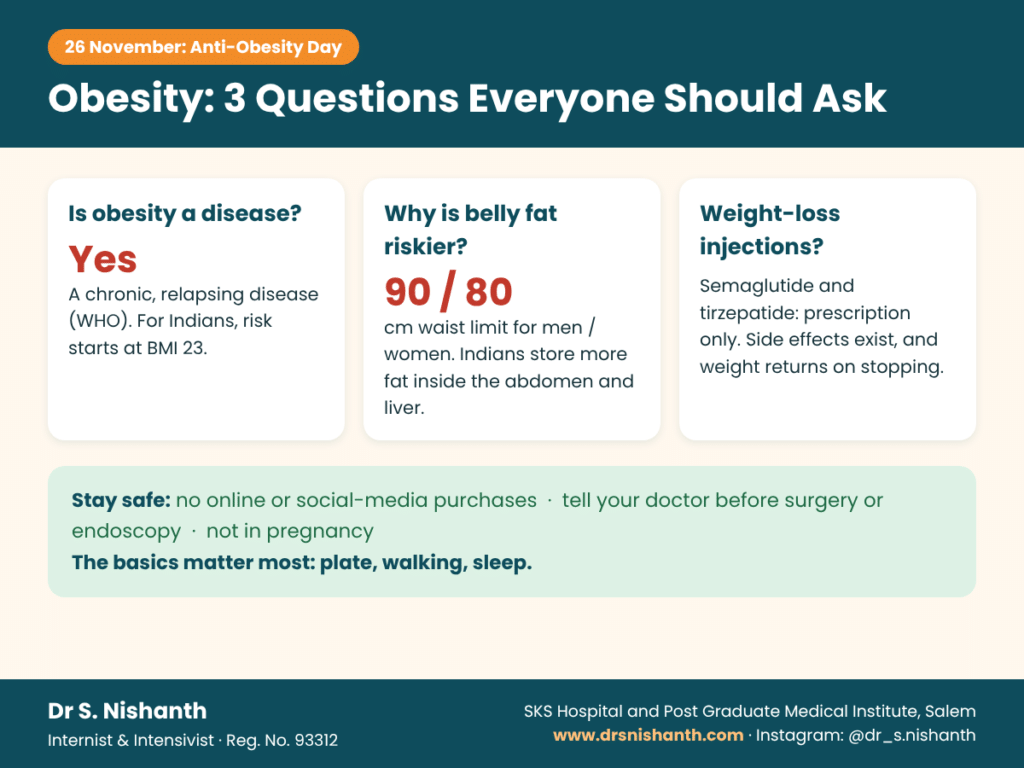
Is obesity a disease?
Short answer: Yes. The World Health Organization now describes obesity as a chronic, relapsing disease. In other words, it is a long-term condition that needs ongoing care, much like diabetes or high blood pressure, and not a personal weakness.
What the new definitions say
In January 2025, a global Lancet Commission, endorsed by 75 medical organisations, separated obesity into two states. Preclinical obesity means excess body fat while the organs still work normally, but the future risk of disease is higher. Clinical obesity, on the other hand, means excess fat is already harming the body, for example through breathlessness, knee pain that limits walking, fatty liver, sleep apnoea or diabetes.
Similarly, Indian experts revised the definition of obesity for Asian Indians in 2025. Under this guidance:
- Stage 1 obesity: BMI above 23 kg/m² without effects on organ function or daily activities
- Stage 2 obesity: BMI above 23 kg/m² together with excess belly fat (waist size or waist-to-height ratio), and related problems such as diabetes, knee arthritis or difficulty with daily activities
Notably, the old “overweight” label has been dropped for Indians, because many Indians develop diabetes and heart disease at a BMI that Western charts would call normal.
How do I check my BMI?
Simply put, BMI is your weight in kilograms divided by your height in metres squared. For example, a person weighing 70 kg with a height of 1.65 m has a BMI of 70 ÷ (1.65 × 1.65) = 25.7. For Indians, therefore, this already counts as obesity. However, BMI alone does not tell the whole story, which is why waist size matters too.
Why calling obesity a disease matters
To begin with, obesity has many causes: genes, hormones, poor sleep, stress, certain medicines, and a food environment full of cheap, tasty, ultra-processed snacks. Because of this, blaming a person does not help. Instead, recognising obesity as a disease means people can get proper medical care early, before complications appear.
Why is belly fat more dangerous for Indians?
Short answer: At the same body weight, Indians tend to store more fat inside the abdomen and around the liver. This hidden fat is the most harmful kind, so diabetes, fatty liver and heart attacks appear earlier, often in people who do not look heavy.
The “thin-fat Indian”
For this reason, doctors often describe the “thin-fat Indian”: a person with normal-looking arms and legs but a soft, protruding belly. In fact, the national ICMR-INDIAB study found that 39.5% of Indian adults have abdominal obesity, compared with 28.6% who have general obesity. In other words, more Indians have a big belly than a high BMI.
What belly fat does inside the body
Importantly, fat inside the abdomen (visceral fat) is not just stored energy. Instead, it acts like an active organ. In particular, it releases fatty acids and inflammatory chemicals straight into the liver. As a result, the body becomes resistant to insulin, blood sugar rises, triglycerides go up and good HDL cholesterol falls. Over time, this leads to:
- Type 2 diabetes, often in the 30s and 40s
- Fatty liver disease
- High blood pressure and abnormal cholesterol; see our lipid profile guide
- Heart attack and stroke at a younger age
- Sleep apnoea (loud snoring with pauses in breathing)
- In women, irregular periods and PCOS-related problems
How to measure your waist at home
- Stand straight and breathe out gently.
- Place a tape midway between your lowest rib and the top of your hip bone (usually around the navel).
- Keep the tape snug but not tight.
For Indians, a waist of 90 cm (about 35.5 inches) or more in men and 80 cm (about 31.5 inches) or more in women signals excess belly fat. Another simple rule is that your waist should be less than half your height.
The good news about belly fat and obesity
Fortunately, visceral fat is usually the first fat to go when you lose weight. In fact, even a 5–10% weight loss can lower blood sugar, BP and liver fat. For example, in the Indian Diabetes Prevention Programme, lifestyle changes alone reduced the risk of diabetes by about 28.5% in people with prediabetes. Read more in our guide to reversing prediabetes with Tamil Nadu food choices.
What are semaglutide and tirzepatide, the new obesity injections?
Short answer: They are prescription medicines, usually given as a once-weekly injection, that copy natural gut hormones which control appetite. They can help people with obesity lose 15–20% of body weight when combined with diet and exercise. However, they are not cosmetic shots, they have side effects, and they must be taken only under a doctor’s supervision.
How do they work?
First of all, semaglutide copies a gut hormone called GLP-1. Tirzepatide copies two hormones, GLP-1 and GIP. Together, these effects reduce hunger, make you feel full sooner, slow down stomach emptying and improve blood sugar control. Consequently, people eat less without constant hunger.
How well do they work for obesity?
- In the STEP 1 trial, adults with obesity on semaglutide lost about 15% of body weight over 68 weeks, compared with about 2.4% on placebo.
- In the SURMOUNT-1 trial, tirzepatide at the highest dose led to about 21% weight loss over 72 weeks.
- In the SELECT trial, semaglutide reduced heart attacks, strokes and cardiovascular deaths by about 20% in people with obesity and existing heart disease.
In December 2025, the WHO issued its first guideline on these medicines. It conditionally recommends them for long-term treatment of obesity in adults, except pregnant women, alongside healthy diet and physical activity. The recommendation is conditional because long-term safety data are still limited, weight often returns after stopping, and costs are high.
Are they available in India?
Yes. To begin with, tirzepatide was approved by India’s drug regulator (CDSCO) and launched in 2025. Moreover, the patent on semaglutide expired in India on 20 March 2026, and many Indian companies have since launched generic versions at much lower prices. Lower cost improves access; on the other hand, it also raises the risk of misuse without medical supervision.
Who may benefit from obesity injections?
Above all, your doctor decides, after looking at your BMI, waist, blood tests and other illnesses. Generally, these medicines are considered for people with clinical obesity or obesity with related diseases such as diabetes, heart disease, fatty liver or sleep apnoea, usually after lifestyle changes alone have not been enough. They are not meant for losing a few kilos before a wedding or a trip.
Who should not take them?
- Pregnant women, women planning pregnancy and breastfeeding mothers
- People with a personal or family history of medullary thyroid cancer or MEN2 syndrome
- People with a past history of pancreatitis, unless a specialist advises otherwise
- Children and teenagers, unless prescribed by a specialist
What are the common side effects?
- Nausea, vomiting, loss of appetite, constipation or diarrhoea, especially in the first few weeks and after each dose increase
- Dehydration, which can strain the kidneys if you are vomiting and not drinking enough fluids
- Gallstones, especially with rapid weight loss
- Rarely, pancreatitis: severe upper abdominal pain spreading to the back needs urgent medical care
- Muscle loss, if protein intake and exercise are poor; see our vegetarian protein guide
- Low blood sugar, if taken together with insulin or certain diabetes tablets
An important warning from the ICU
Because these medicines slow stomach emptying, food can remain in the stomach for longer than usual. Therefore, if you are on semaglutide or tirzepatide, always inform your surgeon, anaesthetist or endoscopy doctor before any procedure. This simple step helps reduce the risk of food entering the lungs during anaesthesia.
What happens if I stop the injection?
Unfortunately, weight usually comes back. For instance, one year after stopping semaglutide in the STEP 1 extension study, people regained about two-thirds of the weight they had lost. This is why doctors treat obesity as a long-term disease, and why diet, activity and sleep habits must be built alongside the medicine.
Beware of fake obesity injections
For example, in April 2026, drug control authorities seized counterfeit tirzepatide pens in Gurugram. Doctors have warned that injections sold outside licensed pharmacies, or through Instagram, WhatsApp and other social media without a valid prescription, are a warning sign. So, buy only with a doctor’s prescription from a licensed pharmacy, and never use “research-grade” or home-mixed products.
What can I do about obesity from today?
Short answer: Start with your waist, your plate and your daily steps. Medicines and surgery are tools for selected people, not a replacement for these basics.
- Measure your waist today and note it down.
- Fix your plate: half vegetables, a quarter protein (dal, egg, fish, paneer, sundal), a quarter rice or chapati.
- Cut packets and sugary drinks, as explained in our post on ultra-processed foods.
- Move every day: at least 150 minutes of brisk walking per week, plus muscle-strengthening exercise twice a week.
- Sleep 7–8 hours, because poor sleep increases hunger hormones.
- Get checked: fasting sugar or HbA1c, lipid profile, liver tests and BP, especially if obesity, diabetes or heart disease runs in your family.
Finally, for people with severe obesity and serious related diseases, bariatric (weight-loss) surgery remains an effective option, after proper evaluation by a specialist team.
When should I see a doctor about obesity?
In general, see your doctor if your waist is above the Indian limits, if your weight has been rising steadily, or if you have loud snoring, breathlessness on climbing stairs, knee pain, excessive thirst or tiredness. Likewise, please talk to a doctor before starting any weight-loss injection; do not start it based on a friend’s advice or an online advertisement. If you already take BP or sugar tablets, read why these tablets control, but do not cure.
About the author: Dr S. Nishanth, MBBS, MD, DNB (General Medicine), MRCP (UK), FNB (Critical Care), EDIC, FECMO. Head – Department of Critical Care Medicine, SKS Hospital and Post Graduate Medical Institute, Salem. Reg. No. 93312. Website: www.drsnishanth.com | Instagram: @dr_s.nishanth
Disclaimer: This article is for general awareness only. It does not recommend any brand or product, and it does not replace a personal consultation with your doctor. Weight-loss medicines must be taken only on a doctor’s prescription.
References
- World Health Organization. WHO issues global guideline on the use of GLP-1 medicines in treating obesity. 1 December 2025. WHO news release
- Rubino F, et al. Definition and diagnostic criteria of clinical obesity. Lancet Diabetes Endocrinol 2025;13(3):221-262. PubMed
- Misra A, et al. Revised definition of obesity in Asian Indians living in India. Diabetes Metab Syndr 2025;19(1):102989. PubMed
- Anjana RM, et al. Metabolic non-communicable disease health report of India: the ICMR-INDIAB national cross-sectional study (ICMR-INDIAB-17). Lancet Diabetes Endocrinol 2023;11(7):474-489. PubMed
- Ramachandran A, et al. The Indian Diabetes Prevention Programme shows that lifestyle modification and metformin prevent type 2 diabetes in Asian Indian subjects with impaired glucose tolerance (IDPP-1). Diabetologia 2006;49(2):289-297. PubMed
- Wilding JPH, et al. Once-weekly semaglutide in adults with overweight or obesity (STEP 1). N Engl J Med 2021;384:989-1002. NEJM
- Jastreboff AM, et al. Tirzepatide once weekly for the treatment of obesity (SURMOUNT-1). N Engl J Med 2022;387:205-216. NEJM
- Lincoff AM, et al. Semaglutide and cardiovascular outcomes in obesity without diabetes (SELECT). N Engl J Med 2023;389:2221-2232. NEJM
- Wilding JPH, et al. Weight regain and cardiometabolic effects after withdrawal of semaglutide: the STEP 1 trial extension. Diabetes Obes Metab 2022;24(8):1553-1564. PubMed
- Business Today. Generic semaglutide launches in India after patent expiry, 20 March 2026; and Eli Lilly India warning on counterfeit tirzepatide, 30 April 2026. Business Today