Intermittent Fasting: How to Do It, Benefits and Common Mistakes
Intermittent fasting is one of the most talked-about ways to lose weight today. Many of my patients in Salem ask me whether it really works, how to do it, and whether it is safe for them. So, in this simple question-and-answer guide, I explain how to do intermittent fasting the right way, what the real benefits are, and which common mistakes you should avoid.
Written by Dr S. Nishanth, MBBS, MD, DNB (General Medicine), MRCP (UK), FNB (Critical Care), EDIC, FECMO – Internist & Intensivist, Head – Department of Critical Care Medicine, SKS Hospital and Post Graduate Medical Institute, Salem. Reg. No. 93312.
What is intermittent fasting?
Short answer: Intermittent fasting means planning when you eat, not only what you eat. You eat only during a fixed number of hours in the day and take no food for the rest of the time.
For example, if you finish dinner at 7 pm and eat breakfast at 9 am, you have already fasted for 14 hours. In other words, intermittent fasting simply stretches the natural overnight gap in a planned way. However, it is not a magic diet. Instead, it is a tool that helps many people eat less in total, because there are fewer hours in which to eat.
What are the common types of intermittent fasting?
Short answer: The easiest type is time-restricted eating, such as 12:12, 14:10 or 16:8 (hours of fasting : hours of eating).
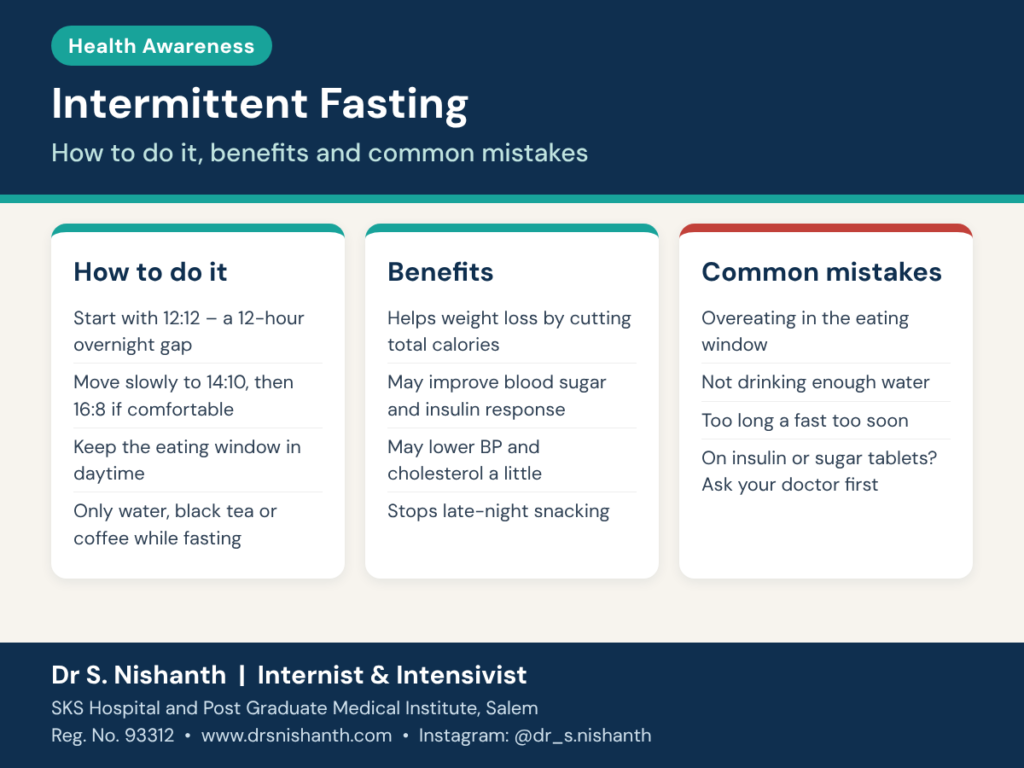
- 12:12 – 12 hours of fasting and 12 hours of eating. This is the best starting point for most people.
- 14:10 – for example, eating between 9 am and 7 pm.
- 16:8 – for example, eating between 10 am and 6 pm. Try this only once your body is used to shorter fasts.
- 5:2 pattern – eating normally on 5 days and eating very little on 2 non-consecutive days. This needs more planning, so it is not ideal for beginners.
Research reviews also describe alternate-day fasting; however, it is harder to follow and is best done only under medical guidance.
How do I start intermittent fasting safely?
Short answer: Start slowly with a 12-hour overnight gap, then increase it step by step over a few weeks.
- First, stop eating after dinner and avoid late-night snacks. This alone gives you a 12-hour fast.
- Next, after one or two weeks, move to 14:10 if you feel well.
- Then, try 16:8 only if it fits your work, sleep and health.
- Also, keep your eating window in the daytime. Eating early in the day suits our body clock better than eating late at night.
- Finally, choose a timing you can follow for months, because consistency matters more than the number of hours.
What can I eat and drink during intermittent fasting?
Short answer: During the fasting hours, take only water and drinks without sugar or milk. During the eating hours, eat a balanced plate, not a feast.
In the fasting window, you may have plain water, black coffee, or tea without sugar and milk. Similarly, plain lemon water without sugar is fine. On the other hand, juices, milk, biscuits and “just one sweet” break the fast.
In the eating window, build each meal around vegetables, a good protein source and a moderate amount of rice, chapati, idli or millet. For instance, a plate of two to three idlis with sambar and vegetables, or rice with dal, keerai, curd and an egg or a piece of fish, works well. If you are vegetarian, read my guide on rich vegetarian protein sources. Likewise, my article on hidden sugar in Tamil Nadu food shows how to keep the carbohydrate load low.
What are the real benefits of intermittent fasting?
Short answer: Intermittent fasting can help with weight loss, blood sugar, blood pressure and cholesterol, mainly because people end up eating fewer calories.
- Weight loss – fewer eating hours usually means fewer total calories.
- Better blood sugar control – studies show improved insulin sensitivity in many people.
- Blood pressure and cholesterol – modest improvements have been reported in several studies.
- Less late-night snacking – a clear “kitchen closed” time breaks a common habit.
- Simplicity – you watch the clock instead of counting every calorie.
A well-known review in the New England Journal of Medicine described how fasting makes the body switch from sugar to fat as fuel, which may explain some of these effects (de Cabo and Mattson, 2019). However, an important trial in 2022 compared eating within an 8-hour window plus calorie cutting against calorie cutting alone. After 12 months, weight loss was not significantly different between the two groups (Liu et al., NEJM 2022). Therefore, the honest message is this: intermittent fasting works mostly because it helps you eat less. If it is easier for you to follow than a regular diet, that is its real strength.
What are the common mistakes in intermittent fasting?
Short answer: The biggest mistakes are overeating in the eating window, not drinking enough water, and starting with very long fasts.
- Overeating after the fast – biryani, sweets and fried snacks in the eating window can cancel out all the benefit.
- Not drinking enough water – this leads to headache, tiredness and constipation.
- Too much, too soon – jumping straight to 16–18 hours of fasting often causes giddiness and makes people give up.
- Too little protein and no exercise – as a result, you lose muscle along with fat.
- Late-night eating windows – for example, eating from 2 pm to 11 pm works against your body clock.
- Starting without medical advice when you take tablets or insulin for diabetes.
Who should not try intermittent fasting without a doctor’s advice?
Short answer: People on insulin or sugar-lowering tablets, pregnant or breastfeeding women, children, and people with kidney disease, heart disease or an eating disorder should check with their doctor first.
The main danger in diabetes is a sudden fall in blood sugar (hypoglycaemia), especially with insulin or sulfonylurea tablets such as glimepiride or gliclazide (NIDDK; Cleveland Clinic Journal of Medicine). So, never skip or change your medicines on your own. Instead, your doctor may adjust the dose or timing. You can read more in my articles on taking tablets during fasting, insulin myths and diabetes explained.
- People with diabetes on insulin or sugar tablets
- Pregnant women and breastfeeding mothers
- Children and teenagers
- People with kidney disease, heart disease or low blood pressure
- Anyone with a past or present eating disorder
- Elderly people who are frail or underweight
Is intermittent fasting safe for the heart in the long term?
Short answer: We do not know for sure yet. Short-term studies look positive, but long-term heart safety, especially for very short eating windows, is still being studied.
In 2024, a preliminary study presented at an American Heart Association meeting linked eating within less than 8 hours a day to a higher risk of death from heart disease (AHA newsroom, 2024). However, that study was based on people’s food recall and was not yet a full peer-reviewed paper, so it cannot prove cause and effect. Even so, it is a good reason to avoid extreme fasting and to prefer moderate windows such as 12:12 or 14:10, particularly if you already have heart disease. Also, keeping your cholesterol and BP under control remains essential.
When should I stop fasting and see a doctor?
Short answer: Stop and eat immediately if you feel giddy, shaky, sweaty, confused or have palpitations, and see a doctor if this keeps happening.
These can be signs of low blood sugar or dehydration. Likewise, if you notice fainting, chest pain, very low urine output or unexplained weight loss, consult a doctor without delay.
Key points about intermittent fasting
- Intermittent fasting is about when you eat; nevertheless, what you eat still matters most.
- Start with 12:12 and increase slowly.
- Keep the eating window in the daytime and avoid late-night meals.
- Its benefits come mainly from eating fewer calories.
- If you have diabetes or any chronic illness, talk to your doctor before you start.
This article is for general awareness and does not replace a consultation with your doctor.
References
- de Cabo R, Mattson MP. Effects of Intermittent Fasting on Health, Aging, and Disease. N Engl J Med. 2019;381:2541–2551.
- Liu D, et al. Calorie Restriction with or without Time-Restricted Eating in Weight Loss. N Engl J Med. 2022;386:1495–1504.
- NIDDK (NIH). Fasting Safely with Diabetes.
- NIDDK (NIH). What Can You Tell Your Patients About Intermittent Fasting and Type 2 Diabetes?
- Olansky L. Strategies for management of intermittent fasting in patients with diabetes. Cleve Clin J Med. 2017;84(5):357–358.
- American Heart Association Newsroom. 8-hour time-restricted eating linked to a 91% higher risk of cardiovascular death (preliminary abstract), March 2024.